

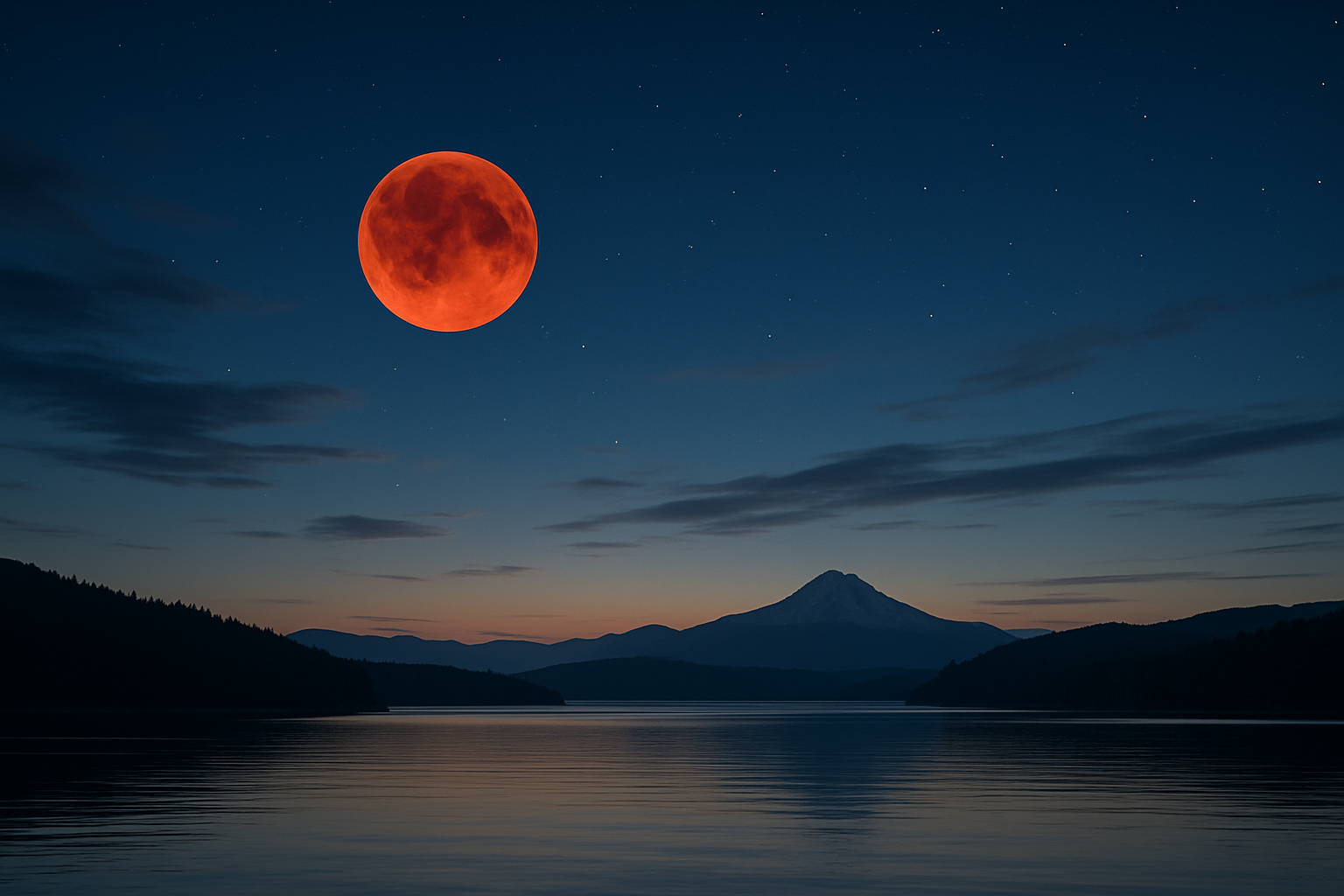

Residents across Southwest Washington and Northwest Oregon are expected to have a clear view of a rare total lunar eclipse on March 3, 2026. According to reporting by Wired, the eclipse will unfold in the early morning hours and briefly turn the moon a deep red as it passes through Earth’s shadow. The moment of peak totality is expected to occur just before sunrise.
National and international astronomy coverage indicates this will be the only total lunar eclipse of 2026 and the last one until late 2028. As described by Space.com, totality will last approximately 58 minutes, with the entire event spanning several hours as the moon darkens, reddens, and eventually returns to full brightness.
Local observers in Washington and Oregon may have especially favorable viewing. Regional forecasting and skywatch guidance reported by the County Herald in its Washington–Oregon Sky Alert 2026 suggests the Pacific Northwest will offer some of the best vantage points on the West Coast, with the moon remaining relatively high in the sky throughout peak totality. Cloud conditions will determine actual visibility, but typically clearer early‑morning skies east of the Coast Range increase the odds of unobstructed viewing across Cowlitz County and the Columbia River corridor.
Astronomers emphasize that lunar eclipses are safe to view without protective eyewear. As outlined by Live Science, the reddish glow—often referred to as a “blood moon”—occurs when sunlight scatters through Earth’s atmosphere, filtering out shorter wavelengths and leaving only long red and orange wavelengths to illuminate the moon.
For communities in Longview, Kelso, and throughout Cowlitz County, the event offers a rare pre‑dawn spectacle requiring only an unobstructed horizon and cooperative weather. While exact local timing may vary slightly by location, most of the region can expect the eclipse to be underway before sunrise, with the most dramatic phase occurring roughly during the 6:00 a.m. hour Pacific Time.
Residents planning to observe the eclipse should monitor local weather forecasts for cloud cover and consider scouting a viewing location with open eastern and southeastern visibility. Even partial views can offer a striking sight as the moon dims and shifts to deep copper.
Why this matters: Total lunar eclipses visible from the Pacific Northwest are uncommon, and the March 3 event provides an accessible, early‑morning opportunity for residents to witness a major astronomical phenomenon without special equipment. For many local schools, science programs, and community organizations, the eclipse presents a natural opportunity for public science engagement and STEM‑related activities.