

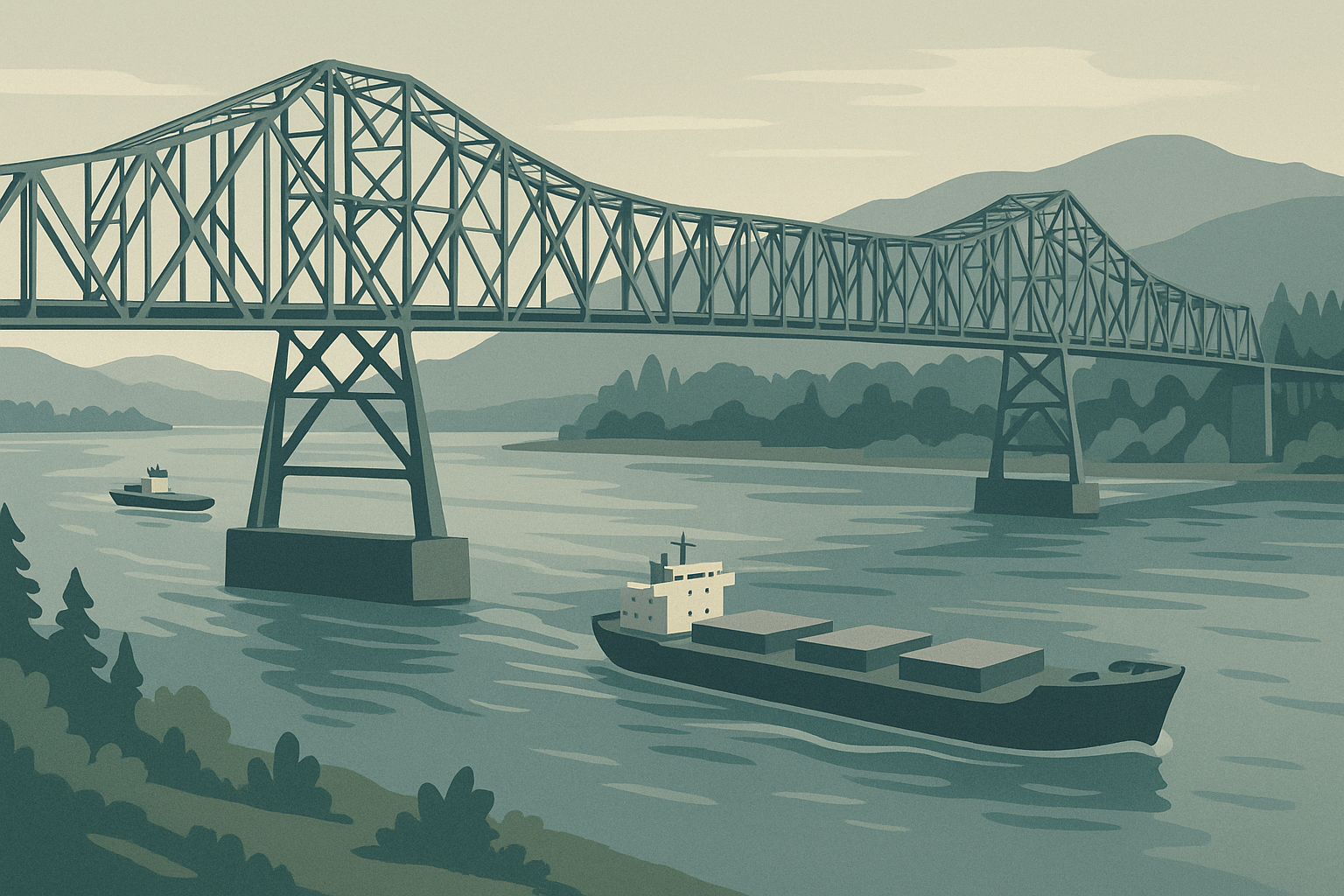

Washington state transportation officials and the U.S. Coast Guard are evaluating new steps to reduce the risk of a commercial vessel striking the Lewis and Clark Bridge in Longview. According to information reviewed by Columbia Countercurrent, these discussions follow a series of national assessments urging agencies to take a closer look at vulnerable river crossings.
In communications cited by the Washington State Department of Transportation and the U.S. Coast Guard, officials have been examining whether additional safeguards are warranted for the 1929 span, which carries State Route 433 across the Columbia River between Longview and Rainier, Oregon. The bridge was included in a broader National Transportation Safety Board call for vulnerability assessments of bridges at risk of vessel collisions, detailed in recent reporting by OPB. That report urged federal and state agencies to coordinate on identifying structures where ship strikes could lead to catastrophic failure.
Local considerations have also intensified. Legislative proposals highlighted by regional reporting and public statements from state lawmakers have stressed that the Lewis and Clark Bridge faces growing pressures from increasing cargo traffic on the Columbia River. A separate bill previewed for the 2025 legislative session would direct state authorities to study pier protection measures such as engineered fenders or barrier installations, according to materials published by The Wahkiakum County Eagle.
The U.S. Coast Guard has also continued issuing safety guidance for maritime operations more broadly. In a recent Marine Safety Alert, published by The Maritime Executive, the agency recommended more rigorous planning and communication during cargo handling. Although the alert was not specific to the Columbia River, federal officials emphasized that rapidly shifting maritime conditions require updated risk management around ports and navigation channels.
Washington’s transportation engineers maintain that the Lewis and Clark Bridge is regularly inspected and currently rated in fair condition, as reported by OPB. Still, national guidance encourages a formal evaluation of whether aging bridge structures should incorporate new protections in response to changes in vessel size, traffic patterns, and navigational risks.
Several prior assessments by the U.S. Army Corps of Engineers have considered potential adjustments to the Columbia River shipping channel. According to reporting from The Astorian, one proposal under review would adjust the channel alignment near Longview to increase distance between deep‑draft vessels and the bridge’s Washington‑side pier. Federal officials indicated that such studies require multiple levels of review and public comment.
State and federal agencies have not announced a timeline for potential actions. At the time of publication, discussions remain focused on evaluation rather than construction or deployment of new protective structures. However, the convergence of federal recommendations and state‑level legislative interest signals a growing emphasis on mitigating the risk of low‑probability but high‑impact events along the Columbia River shipping corridor.
For communities on both sides of the river, the Lewis and Clark Bridge remains a vital connector. Any future protective measures would likely carry regional implications for transportation, maritime operations, and long‑term infrastructure planning.
Sources:
• OPB: “Pacific Northwest bridges identified in federal report as potentially vulnerable to ship collisions.”
• The Wahkiakum County Eagle: “Lewis and Clark Bridge Bill to be introduced.”
• The Maritime Executive: “USCG ‘Strongly Recommends’ Safety Steps for Vessels During Cargo Ops.”
• The Astorian: “Guest Column: Tragedy should prompt safety evaluation of Lewis and Clark Bridge.”