


Introduction
British Columbia will make its final daylight saving time change on March 8, 2026, creating a permanent one‑hour seasonal difference along the Washington–B.C. border unless the U.S. Congress acts. The move, announced by the provincial government in an official statement at news.gov.bc.ca, affects thousands of Southwest Washington residents who travel, work, or communicate across the border.
B.C.’s 2026 Decision and What It Means
According to the provincial announcement, clocks across British Columbia will advance on March 8, 2026, and then remain on permanent daylight saving time. The change follows a public consultation in 2019 in which the provincial government reported overwhelming support for ending seasonal clock adjustments.
Premier David Eby said in the province’s statement that he hopes the shift will eventually be mirrored by neighboring U.S. states that have expressed similar preferences. Attorney General Niki Sharma said the policy is intended to reduce disruption and provide consistency for households, workplaces, and businesses.
Washington’s Law—and Its Limitations
Washington passed its own permanent daylight saving time law in 2019. However, under the federal Uniform Time Act, states may adopt permanent standard time on their own but cannot move to permanent daylight saving time without congressional approval. Washington’s 2019 statute explicitly defers implementation until Congress authorizes such a change.
According to reporting by MyNorthwest, federal action has not advanced since Washington lawmakers first passed the measure. Multiple West Coast states—Washington, Oregon, and California—remain in the same position: state law authorizes the change, but the federal barrier remains.
A One‑Hour Gap at the Border Starting November 2026
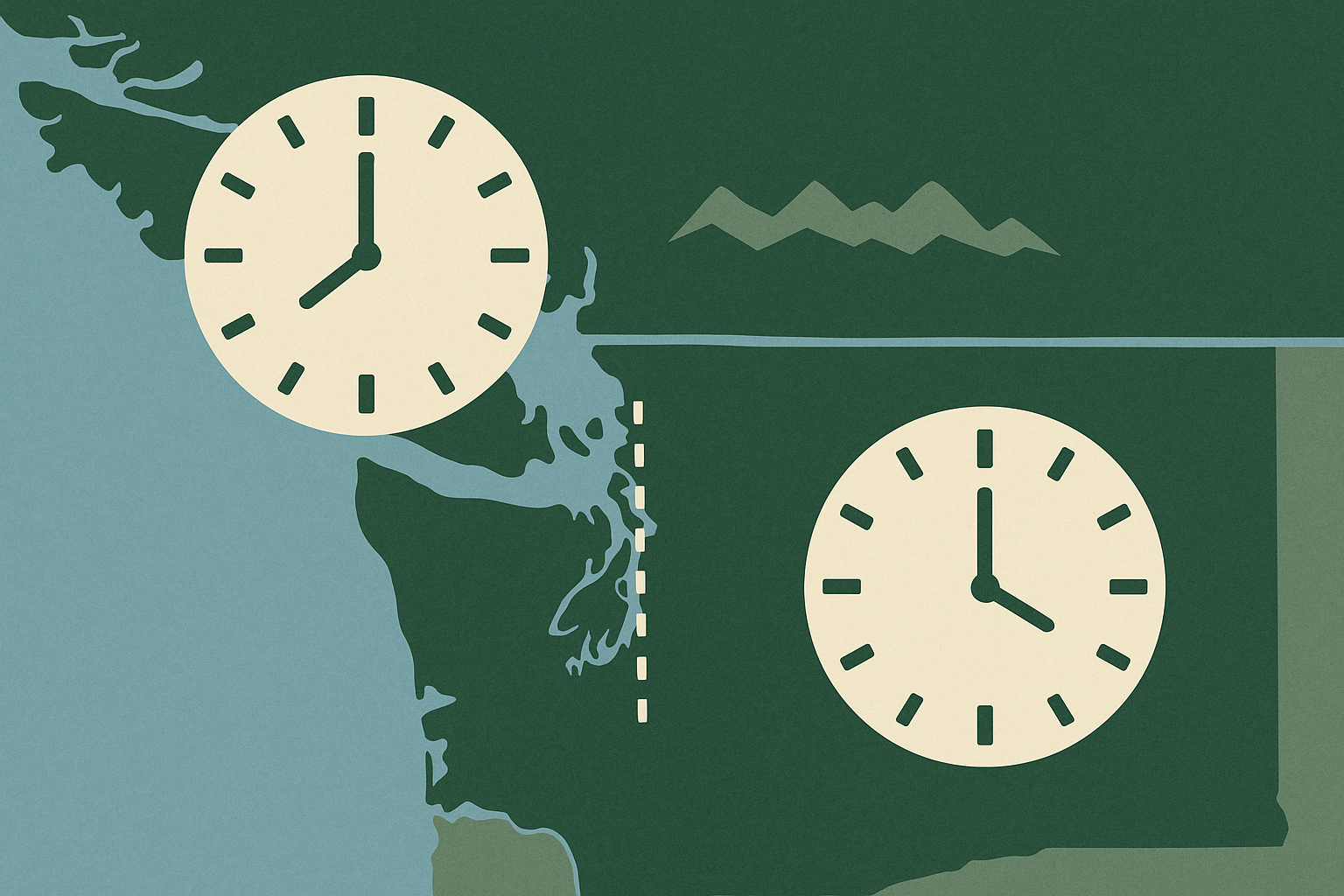
For most of 2026, daily life between British Columbia and Washington will continue on the same schedule. Both jurisdictions will shift clocks forward on March 8. But when Washington falls back to standard time on November 1, 2026, British Columbia will not, creating a one‑hour seasonal difference.
The gap is expected to persist each year from November through March until Congress authorizes permanent daylight saving time or federal law changes. Cross‑border employers, trucking companies, families with members on both sides of the line, and residents in communities throughout Southwest Washington will need to account for the mismatch.
Local and Regional Implications
Southwest Washington residents who rely on connections to the Lower Mainland—whether for business, travel, or communication—may face newly staggered operating hours for airlines, ferries, government services, and cross‑border trade. Telecommunications schedules and remote work arrangements tied to Vancouver‑area businesses may require adjustments during the winter months.
For Cowlitz County and communities along the I‑5 corridor, the change may be most visible in early‑morning and late‑afternoon coordination with British Columbia. The seasonal difference could also affect tourism flows between the Portland–Kelso–Longview corridor and the Lower Mainland, particularly during the holiday travel period.
Why This Matters
The time split touches a longstanding issue in border communities: regional interdependence that does not always align neatly with federal rules. British Columbia’s move highlights how state‑level decisions in the U.S. remain constrained by federal law, even when neighboring governments proceed independently.
Unless Congress acts, Southwest Washington residents will need to navigate a wintertime one‑hour gap not seen in decades—one that affects travel, commerce, public services, and the daily rhythms of cross‑border families.
Sources
- Government of British Columbia: Official announcement on permanent daylight saving time
- MyNorthwest: B.C. ends daylight saving time permanently in 2026. WA is still waiting on Congress
- U.S. Department of Transportation: Uniform Time Act