

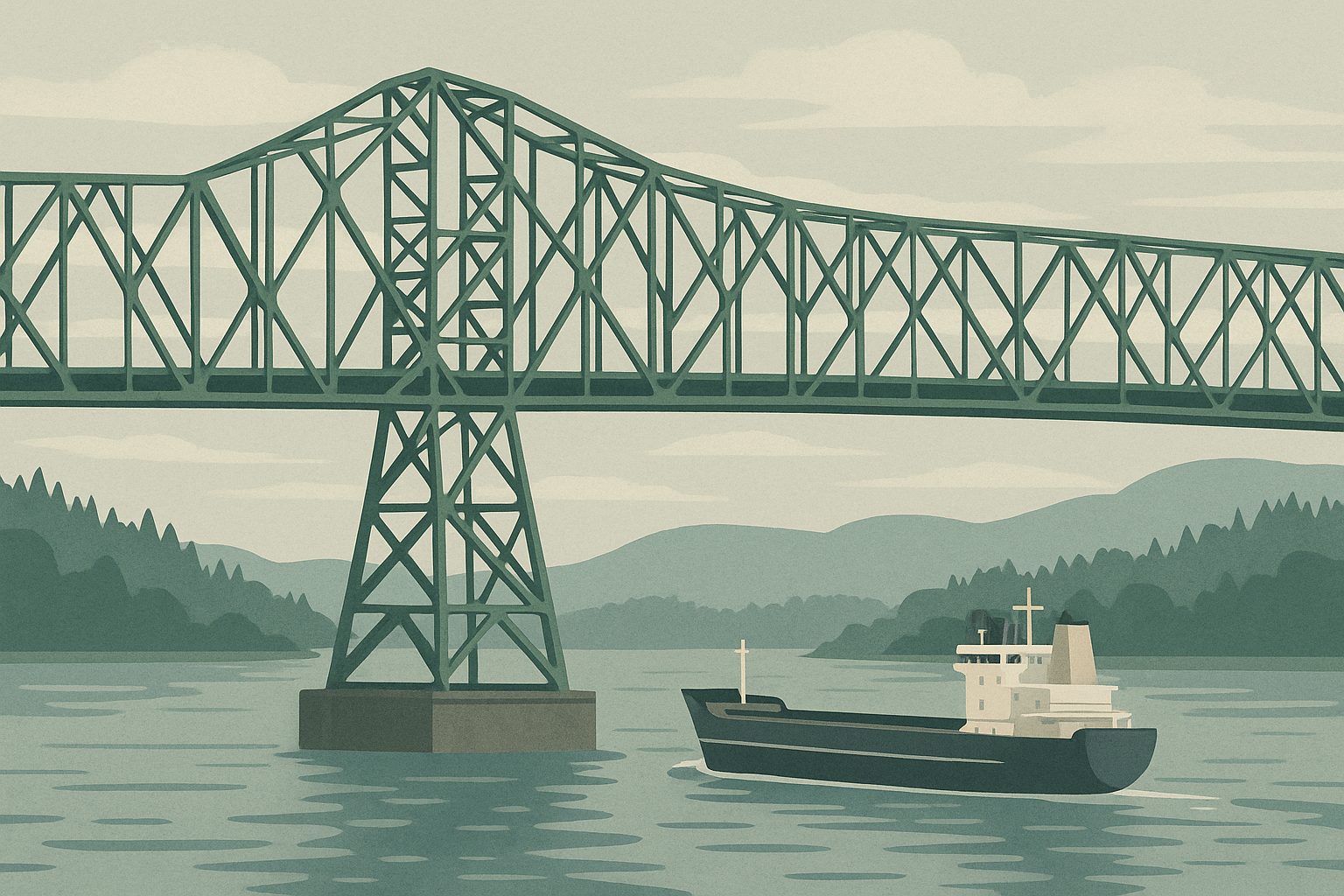

According to reporting by The Reflector, maritime pilots working the Columbia River say large vessels have come within feet of striking the Lewis and Clark Bridge, raising concerns about the structure’s vulnerability and the region’s preparedness for a serious incident.
Pilots told the publication that about four years ago a cruise ship passed under the bridge with only a minimal safety margin, and additional close calls have followed. Capt. Jeremy Nielsen, president of the Columbia River Pilots, said a vessel departing the Port of Longview experienced a power loss beside the bridge during the first weekend of February, requiring tug intervention to keep it from drifting off course. Nielsen also pointed to the collapse of Baltimore’s Francis Scott Key Bridge in March 2024 as a cautionary example, noting that a similar engine‑failure scenario on the Columbia could have severe consequences.
Pilots emphasized that the Lewis and Clark Bridge lacks air‑gap sensors to help determine clearance under changing river levels. According to the reporting, those gaps became alarmingly relevant during a 2022 incident involving the 1,041‑foot cruise ship Celebrity Eclipse, when pilots later learned that natural bridge flex could further reduce an already narrow buffer. A spokesperson for the Washington Department of Transportation told the outlet that bridges are designed to flex slightly with temperature and load, but did not provide a specific measurement for the Lewis and Clark Bridge.
Industry data shared in the reporting indicates that roughly two dozen engine‑failure events occur annually along the full length of the Columbia River shipping route, with an average of about two propulsion or steering failures each month. While most are brief and quickly corrected, pilots expressed heightened concern about failures that occur directly above or below the bridge, where maneuvering options are limited. Nielsen said their priority is to prevent a bridge strike at all costs, even if that means intentionally grounding a vessel to avoid hitting a bridge support.
The Reflector’s reporting also highlighted federal findings. A 2025 National Transportation Safety Board report identified the Lewis and Clark Bridge as one of the Pacific Northwest’s “critical/essential” crossings with unquantified risk from vessel collision. Prior national investigative work, referenced in the article, placed the bridge among several U.S. structures considered particularly susceptible to collapse if struck by large vessels.
Pilots argue that the scale of modern ships has outgrown the river infrastructure built nearly a century ago. The Columbia’s shipping channel has widened since the bridge’s completion in 1930, but vessel size has more than doubled in some segments of the fleet. According to the reporting, channel geometry near Longview leaves pilots navigating a bend that brings large vessels within roughly 80 feet of a bridge support on the Washington side—well within the margin pilots consider acceptable without modern safety systems.
After more than a decade of requests from the Columbia River Pilots and others in the maritime industry, state and federal agencies are now reviewing possible upgrades, including realigning the channel and installing clearance sensors. Discussions are ongoing, and no final decisions have been announced as of the article’s publication.
For residents of Longview and the surrounding region, the pilots’ warnings underscore a growing infrastructure concern. Thousands of large vessels pass beneath the Lewis and Clark Bridge each year, and while pilots say they are trained to handle emergencies, they stress that the current margin for error is narrower than the public may realize.



1 Comment
Are these the same river pilots who are in charge of the ship once it enters the Columbia River?
The same pilots that used to allow the ship to go so fast as to cause massive beach erosion from their wake. I’ve seen massive waves throw 50 plus foot logs over the bank and have a video to prove it. The wake is larger than the waves at the beach in some cases.
I ‘ve noticed that they have slowed down in the daytime but living next to the water It’ pretty easy to tell how fast they’re going after dark and it’s quit a bit faster.
Comments are closed.