

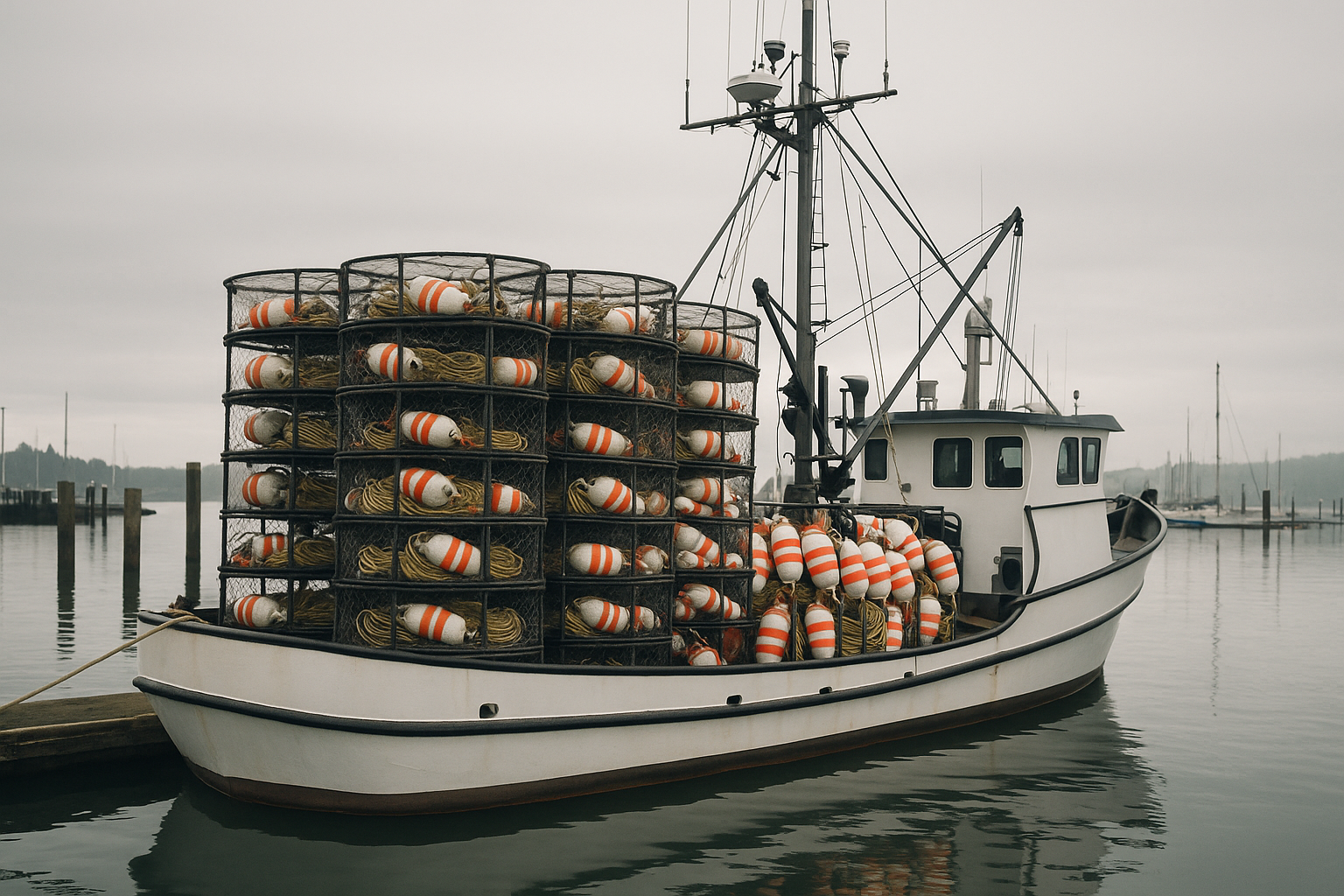

The Oregon Fish and Wildlife Commission voted 6–1 on Friday to deny a petition seeking major changes to commercial Dungeness crabbing rules — a decision with practical implications for seafood distributors, processors, and markets throughout Southwest Washington, where Oregon-caught crab is a key winter commodity.
The petition, submitted in December by the Center for Biological Diversity, Oceana, the Natural Resources Defense Council, and the American Cetacean Society, called for a suite of new rules intended to reduce whale entanglements. According to filings shared by the Center for Biological Diversity through a December 2025 petition announcement, the proposed measures included seasonal restrictions, reduced gear density, and an accelerated pathway for adopting “ropeless” or “pop-up” trap systems.
Whale entanglements in Oregon waters have been a growing concern, with federal agencies documenting multiple incidents in recent years. Conservation groups argue that Oregon has spent five years working toward a required federal Incidental Take Permit under the Endangered Species Act, but has not yet completed a conservation plan or secured the permit. Without it, both the state and the commercial fleet face legal exposure if endangered whales are caught in Oregon gear.
Commercial crabbers, however, warned that the petition’s requirements would bypass Oregon’s existing rulemaking process. Industry members testifying at Friday’s meeting stated that sudden regulatory changes — such as the state’s recent move to shift the annual gear-reduction date from May 1 to April 1 — already strain small operations.
Gary Ripka, president of the Oregon Coast Crab Association, told commissioners that mandatory adoption of ropeless gear would be economically devastating. Ripka said outfitting small vessels could cost more than $300,000, and larger boats could face costs approaching $1 million. While pop-up gear has shown positive test results in California, Oregon crabbers uniformly opposed making its use mandatory before in-state trials occur.
ODFW officials told attendees they expect to begin Oregon-based pop-up gear testing in August.
After more than four hours of testimony, commissioners rejected the petition but directed the agency to continue developing a comprehensive conservation plan.
Though the regulatory dispute is centered on Oregon waters, the outcome matters in Cowlitz County. Much of the fresh Dungeness crab sold in Longview, Kelso, and the broader Southwest Washington region originates from the Oregon commercial fleet. Any shifts in cost, season timing, or vessel participation can affect regional supply, local fish markets, and the winter livelihoods of fishers whose catch moves through Pacific Northwest processing and distribution chains.
For consumers and retailers, Friday’s vote means the state’s current approach — evolving seasonal limits, restricted-depth fishing in late spring, and developing gear experiments — will continue while Oregon works toward its federal conservation requirements.
Why this matters
Dungeness crab is one of the Pacific Northwest’s most economically significant fisheries, and its supply chain is closely intertwined across the Columbia River. Regulatory uncertainty in Oregon can translate into fluctuating availability and pricing for Southwest Washington retailers, restaurants, and consumers. The denied petition keeps the current system in place for now, but the long-term framework — particularly the state’s pursuit of a federal Incidental Take Permit — remains unresolved.
Sources
- Oregon Public Broadcasting: Oregon Fish and Wildlife Commission denies petition to alter Dungeness crabbing rules
- KLCC: Oregon Fish and Wildlife Commission denies petition to alter Dungeness crabbing rules
- Center for Biological Diversity: Oregon petition announcement




Leave a Comment