

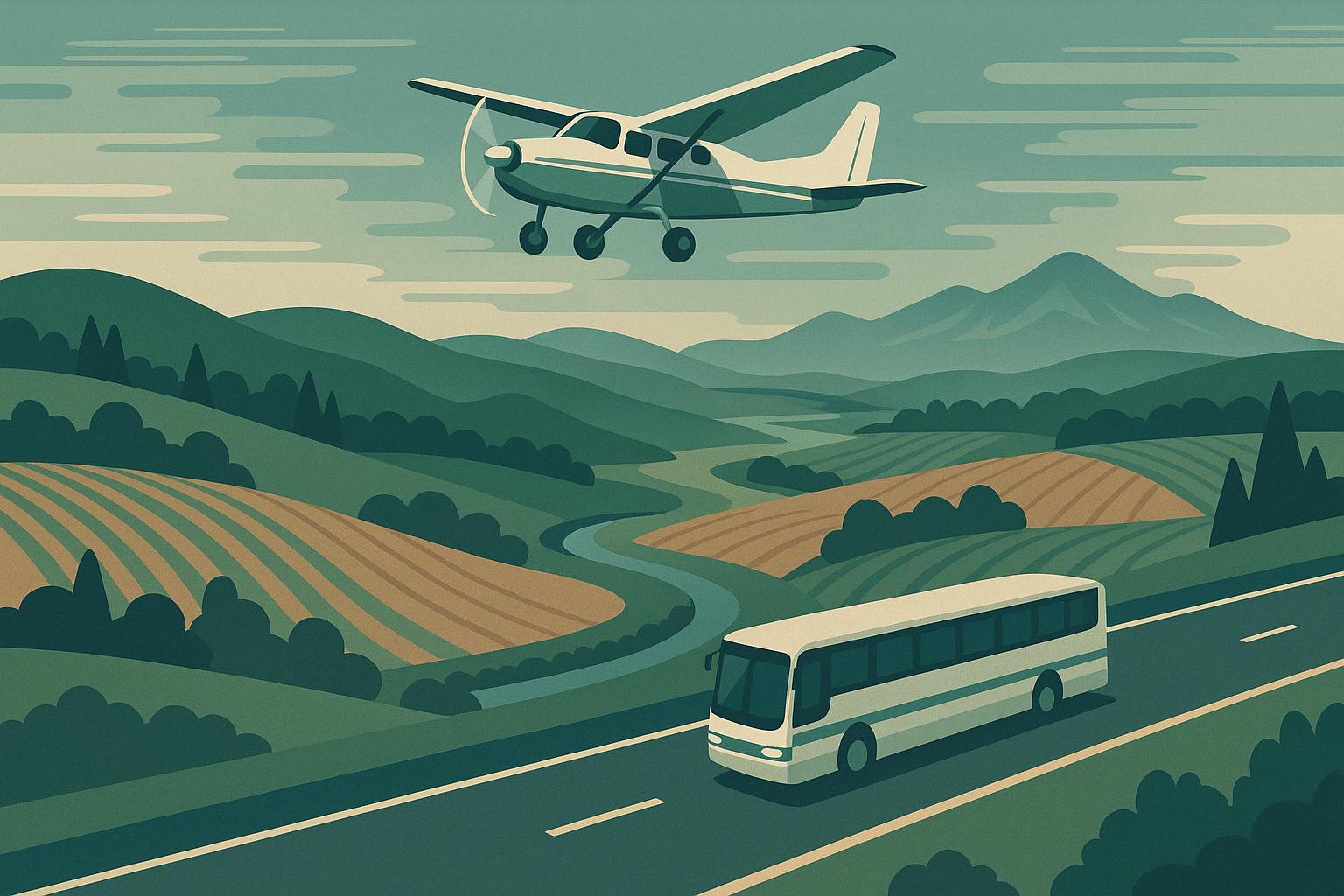

For much of rural America, long-distance travel increasingly depends on shrinking networks of subsidized air routes and disappearing bus lines. According to reporting by Oregon Public Broadcasting, the federal Essential Air Service program is now underwriting more than $500 million in flights annually to ensure small communities remain connected to larger cities. One of those flights is the eight-seat Pendleton–Portland route, which continues to operate only because the federal government covers nearly 80% of its cost.
Federal documents published by the U.S. Department of Transportation show that the Pendleton service receives $4.2 million per year to serve just under 8,000 passengers. Airport officials cited in the OPB reporting say that without those subsidies, the 55‑minute hop between Eastern Oregon and Portland would vanish — just as Greyhound’s intercity service has already disappeared from large portions of Oregon.
That loss of bus service became real for residents last year, when Greyhound cancelled its lines through Eastern Oregon, leaving many travelers reliant on a patchwork of tribal transit services and the federally subsidized flight. Local riders described multi-hour journeys with multiple transfers simply to reach a transportation hub with onward connections.
Transportation specialists interviewed in the OPB story argued that rural bus subsidies could connect more people at a lower cost than comparable air routes. They also warned that without expanded support, rural bus systems will continue to contract, leaving many communities with no intercity options at all.
For residents of Southwest Washington — particularly in Cowlitz County, where long-distance bus service has also diminished — the debate unfolding in Pendleton mirrors ongoing regional concerns. Rural health providers here routinely cite transportation gaps as barriers to specialty care in Portland and Vancouver. County staff and local transit agencies have also noted that shrinking commercial bus networks complicate travel for seniors, low-income residents, and workers without access to a car.
Public policy decisions in Washington, D.C., will determine whether subsidies continue to support small-plane connections like Pendleton’s, or whether a renewed focus on intercity bus networks becomes the federal priority. According to reporting by OPB, Oregon is preparing to launch a state‑supported replacement bus line to reconnect the towns Greyhound exited, pending federal funding availability.
While no comparable proposal has been formally announced in Southwest Washington, advocates for expanded rural transit have repeatedly emphasized that regional mobility depends on steady, predictable funding. As the debate over Essential Air Service intensifies, the choices federal lawmakers make will shape how rural communities — including those in Cowlitz County — stay connected to jobs, health care, and family far beyond county lines.
Why this matters
Travel corridors along the I‑5 and I‑84 systems function as lifelines for smaller communities on both sides of the Columbia River. If federal support shifts away from rural bus systems or subsidized air links, residents in places like Longview and Kelso could face longer travel times, higher costs, and fewer safe transportation options. The discussion now under way in Congress will help determine whether rural communities gain broader connectivity or confront new barriers to mobility.
Sources
Oregon Public Broadcasting: In Pendleton, a tiny plane keeps people connected. But could buses do it better?
U.S. Department of Transportation: Subsidized Essential Air Service Report



Leave a Comment