

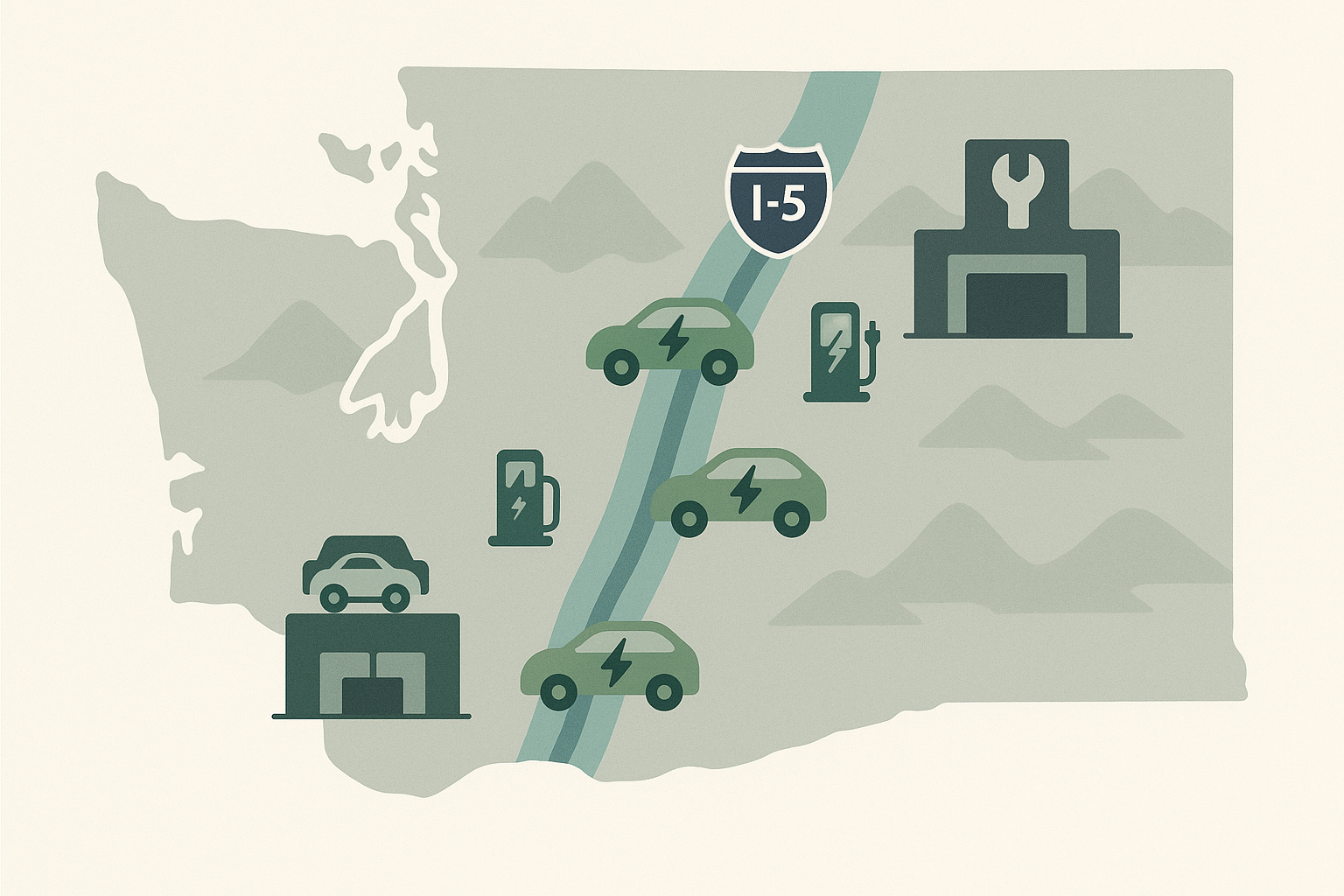

Legislation in Olympia that would open Washington’s auto market to direct sales by electric vehicle makers Rivian and Lucid cleared its first major hurdle late last week, setting up a fast‑moving debate with implications for consumers and businesses along the I‑5 corridor from Longview to Vancouver.
According to reporting by Washington State Standard, Senate Bill 6354 was introduced on Feb. 19 and quickly approved by the Senate Transportation Committee. The measure would allow Rivian and Lucid to sell vehicles directly to customers in Washington—an option currently available only to Tesla under a 2014 statutory carveout.
Minutes from the committee hearing show the bill emerged from private negotiations between the manufacturers and the Washington State Auto Dealers Association, longtime opponents of direct sales. Lawmakers also added a dealer fee increase, with a share of that revenue designated to fund used electric‑vehicle rebates for low‑income residents.
Sen. Marko Liias, who chairs the Senate Transportation Committee, told colleagues the bill reflects a compromise between competing interests. The proposal limits eligibility to U.S. companies that exclusively produce battery‑electric vehicles, have at least 300 vehicles registered in Washington as of Jan. 1, maintain at least one service facility in the state, and have never operated under a franchise agreement. Under those conditions, only Rivian and Lucid would qualify.
The bill would not permit foreign manufacturers or legacy automakers—including companies such as Ford or Toyota—to sell directly or to use subsidiaries to bypass existing dealer networks. Representatives for Rivian, Lucid, and the dealers association publicly backed the agreement during the committee hearing, describing it as a framework that preserves the dealer model while expanding electric‑vehicle access.
Rivian’s political activity has added urgency to the debate. According to filings with the Washington Public Disclosure Commission, the company formed a political committee, the Washington Coalition for Consumer Choice and Innovation, contributing $4.5 million and pledging an additional $20 million to support a possible 2026 ballot initiative if legislative efforts fail. A spokesperson for the coalition said it is prepared to pursue a ballot measure to guarantee direct‑sales options for consumers.
Several participants in last week’s hearing noted they had heard Rivian could be willing to spend significantly more, if necessary, to secure those changes at the ballot.
Automakers that rely on franchise dealerships strongly oppose the bill. In testimony, the Alliance for Automotive Innovation argued all manufacturers should operate under the same rules and warned that expanding exemptions could encourage future attempts by foreign electric‑vehicle companies to enter the U.S. market through direct sales.
Rep. Amy Walen, who chairs the House Consumer Protection and Business Committee and has professional ties to the dealership industry, said she was not aware of the bill before its introduction and believes its current language lacks sufficient consumer protections and requirements for in‑state physical presence. According to the Standard’s reporting, if the bill passes the Senate, it is expected to bypass her committee and move directly to House Transportation.
For Southwest Washington, including Cowlitz County, the proposal could reshape how residents access the growing electric‑vehicle market. Rivian already operates showrooms in the state, but prospective buyers from Longview and Kelso currently must complete sales through out‑of‑state channels or through indirect processes. The bill’s passage would allow local buyers to complete purchases directly, potentially reducing travel, shortening delivery timelines, and opening the door to more service‑center investment along the I‑5 corridor.
Local dealerships could face competitive pressure if Rivian and Lucid open direct‑sales locations within reach of Cowlitz County consumers, though the bill preserves the franchise structure for all existing automakers and limits direct sales to manufacturers that have never operated under that model.
As of March 2, the bill awaits further action in the Senate before potentially moving to the House.
Sources
- Washington State Standard: For Rivian and Lucid, path finally emerges for direct-to-consumer car sales in WA
- Washington State Legislature: SB 6354 bill summary
- Washington Public Disclosure Commission: Washington Coalition for Consumer Choice and Innovation filings




Leave a Comment