
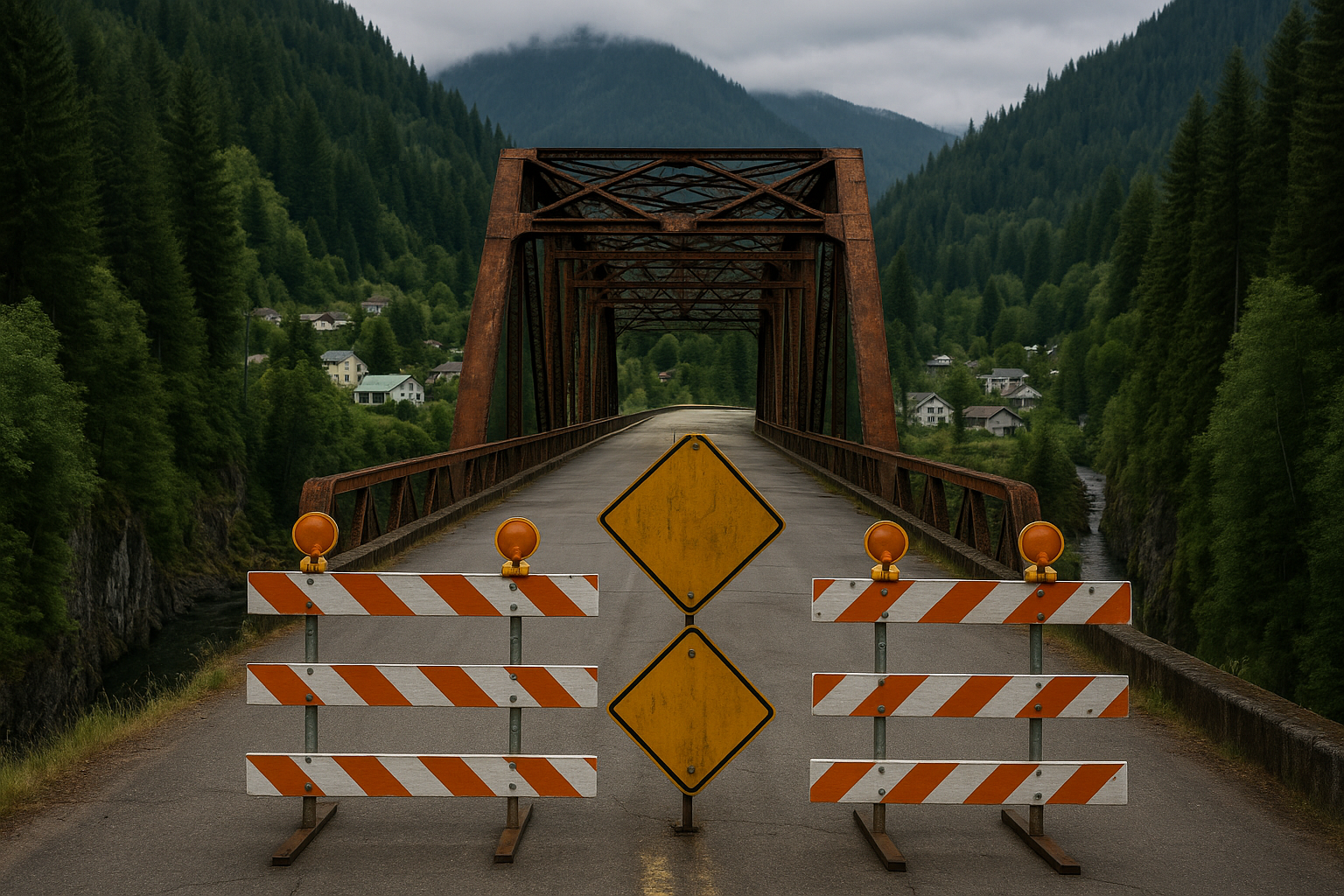

Wilkeson Mayor Jayme Peloli is urging lawmakers in Olympia to treat the long-term closure of the Fairfax Bridge as an emergency threatening her town’s survival. The historic bridge, which connects Wilkeson to Mount Rainier National Park, was shut down last year after inspectors found its century-old steel had degraded beyond safe limits. The Washington State Department of Transportation (WSDOT) has said the deterioration resulted from decades of deferred maintenance.
Peloli told legislators that the loss of the bridge has devastated local business and emergency access. “When that access disappeared, it did not create an inconvenience. It actually severed the system that sustains us,” she said in testimony this week. Visitor traffic fell sharply, seasonal employment collapsed, and businesses along the route to the park lost most of their customers.
Unlike bridges damaged by disasters or vehicle collisions, the Fairfax Bridge’s closure does not qualify for emergency funding or accelerated repairs. WSDOT officials said the bridge’s failure was the result of neglect, not a sudden event, meaning it must go through the full engineering, environmental, and funding process before any replacement can begin. The agency expects that process could take six years.
WSDOT Region Director Steve Roark told lawmakers the only options are to spend at least $160 million on a new bridge north of the existing span or remove the obsolete structure entirely. Because the replacement would be a new bridge on a new alignment, he said, “there’s no advantage at this point to declaring an emergency.”
Two bills now before the Washington Legislature seek to help communities cut off by infrastructure failures. Senate Bill 5987 would give WSDOT authority to waive some procedural hurdles; Senate Bill 6150 would temporarily eliminate business and property taxes for affected areas. But lawmakers have not yet approved either measure, leaving Wilkeson and nearby towns to absorb the fallout.
Mayor Peloli said communities depending on state infrastructure should not have to bear the cost of long-term neglect. “Wilkeson is not the exception,” she said. “Wilkeson is the warning.”
Update: Lawmakers Seek Federal Intervention
With no state emergency declaration forthcoming, Washington lawmakers are now asking the federal government to assist Wilkeson. State Senator Phil Fortunato has introduced a joint memorial urging federal agencies to expedite the rebuilding process by waiving or deferring certain environmental review requirements under the National Environmental Policy Act (NEPA). The proposal, which has received bipartisan support, asks federal officials to move environmental compliance steps closer to the end of the project to shorten overall completion time.
Mayor Peloli testified that federal involvement is now essential, arguing that Washington’s existing process cannot deliver relief quickly enough. “Our state leaders have made it clear that they do not plan to elevate this crisis to the level of urgency that it deserves. Federal involvement is necessary because this crisis has outgrown the pathways currently available at the state level,” she said last week.
Peloli also criticized Governor Bob Ferguson for prioritizing national political issues over the local emergency. “When statewide leaders focus public communication on national public conflict and political conflict, while communities within their own state are navigating infrastructure failure and emergency access, it leaves residents questioning whether their crisis is being seen or prioritized,” she said in prepared remarks. Peloli further asked how much suffering her community must endure before state leadership acts decisively.
In addition to requesting red tape reductions, the joint memorial would ask the federal government to declare the Fairfax Bridge closure an emergency and remove the structure from the National Registry of Historic Places, a designation that currently complicates repair or replacement decisions. The memorial has been heard by both chambers of the Washington Legislature.
The 105-year-old bridge remains closed, cutting off access not only to Wilkeson but also to popular hiking and camping areas in Mount Rainier National Park. WSDOT continues to evaluate options that include either building a new crossing—estimated at $160 million—or demolishing the existing historic span without replacement.
Why this matters: The Fairfax Bridge debate exposes the difference between crisis response and structural neglect in Washington’s infrastructure policy. Small towns such as Wilkeson can be stranded when critical connections fail, even though they lack local tax bases to fund major repairs. With many aging bridges across the state facing similar conditions, the legislative response to Wilkeson could set a precedent for how Washington and federal agencies coordinate on infrastructure emergencies in the years ahead.
Sources: MyNorthwest (original); MyNorthwest (update)