

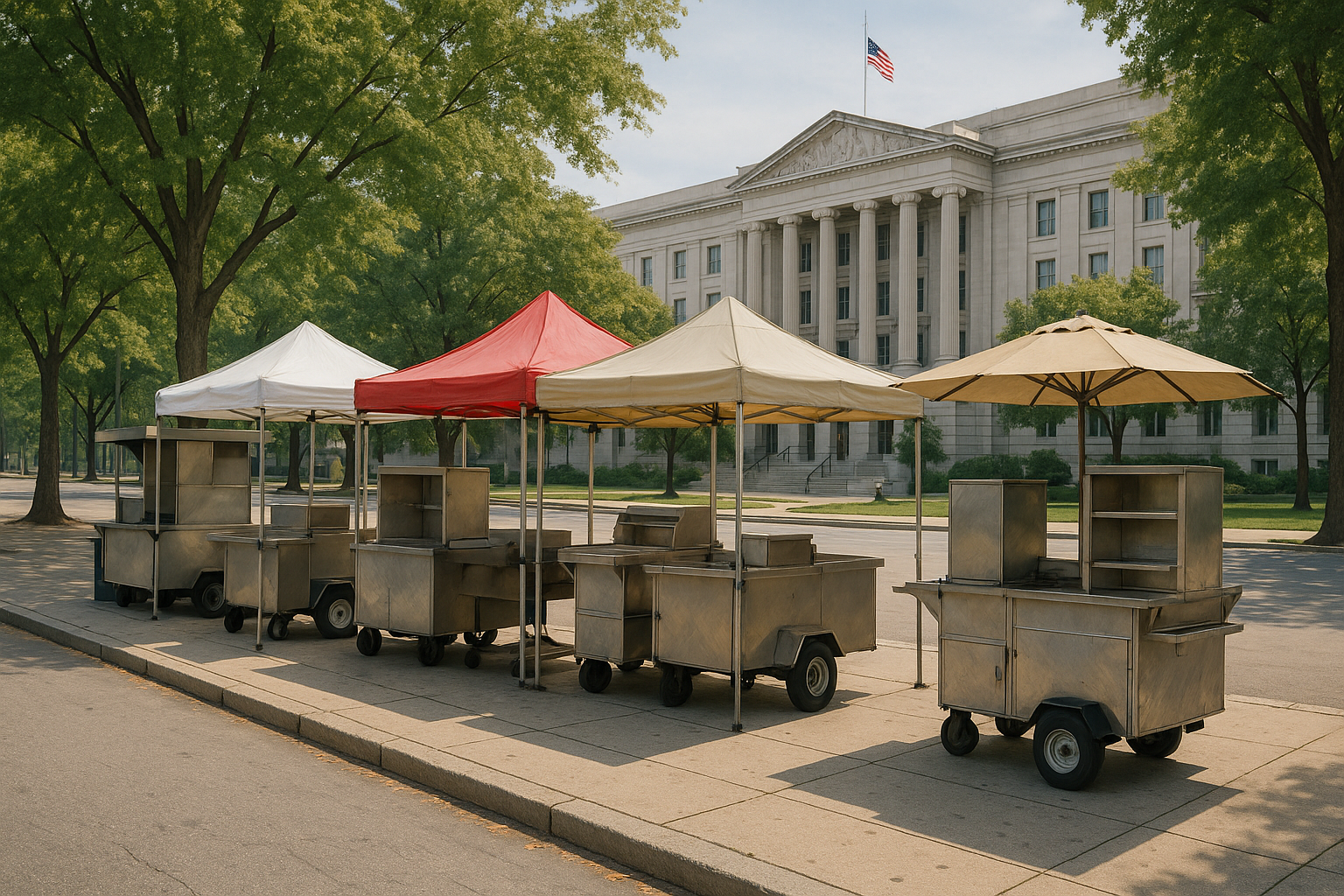

The Everett City Council has unanimously approved a new ordinance creating criminal penalties for operating a food stand without both a city business license and a Snohomish County Health Department permit. The measure, passed during a council meeting last week, authorizes police to confiscate equipment used in unpermitted operations and establishes misdemeanor penalties carrying up to 90 days in jail and fines of up to $1,000 for operators. Employers could face penalties of up to 364 days in jail and $5,000 in fines, according to reporting from The Everett Herald.
Everett officials cited a sharp rise in complaints—16 in 2022 compared with more than 200 in 2025—along with documented foodborne illness reports linked to unpermitted stands. Under the new ordinance, officers will receive training intended to help them identify potential human trafficking indicators and, when appropriate, guide workers toward the proper licensing process. Everett City Attorney David Hall told the council that while written guidelines are still forthcoming, prosecutors will exercise discretion “in accordance with common sense and the intent of the law,” a statement also reported by The Everett Herald.
Council debate acknowledged concerns that some workers at these unlicensed stands may be victims of exploitation or trafficking. Council member Paula Rhyne previously raised the risk that enforcement could fall hardest on frontline employees, while Council member Scott Bader emphasized the need for consistency in enforcement as officials attempt to curb what they describe as unfair competition with permitted vendors.
Permitted vendors in Everett have expressed frustration that unlicensed stands, which do not pay health review fees—$1,100 for initial review and $500 to $1,025 annually—can offer lower prices. To obtain a legal permit, operators must demonstrate access to proper refrigeration, handwashing stations, and other health‑safety requirements.
The ordinance carves out exemptions for lemonade stands, farmers, and nonprofit vendors. Prior exemptions deemed irrelevant, including references to newspaper carriers and campaign workers, were removed before the final vote to narrow the law’s focus strictly to mobile unpermitted food operations.
Although Everett is more than 100 miles north of Cowlitz County, the policy shift highlights issues that frequently surface in southwest Washington: ensuring health‑safety compliance, navigating the economics of street‑level food vending, and determining how local governments should respond when regulatory violations intersect with potential labor exploitation. Neither Longview nor Kelso currently reports complaint volumes comparable to Everett’s, but similar enforcement questions—particularly around mobile food carts and seasonal vendors—regularly arise in local code discussions.
For communities in Cowlitz County, the Everett action offers a preview of policy choices available to municipalities weighing how to balance public health, economic fairness, and equitable treatment of workers. Whether local governments here will revisit their own enforcement frameworks remains an open question.
Sources:
The Everett Herald: Everett approves law to crack down on unpermitted food stands
MyNorthwest: Everett cracks down on unpermitted food vendors