

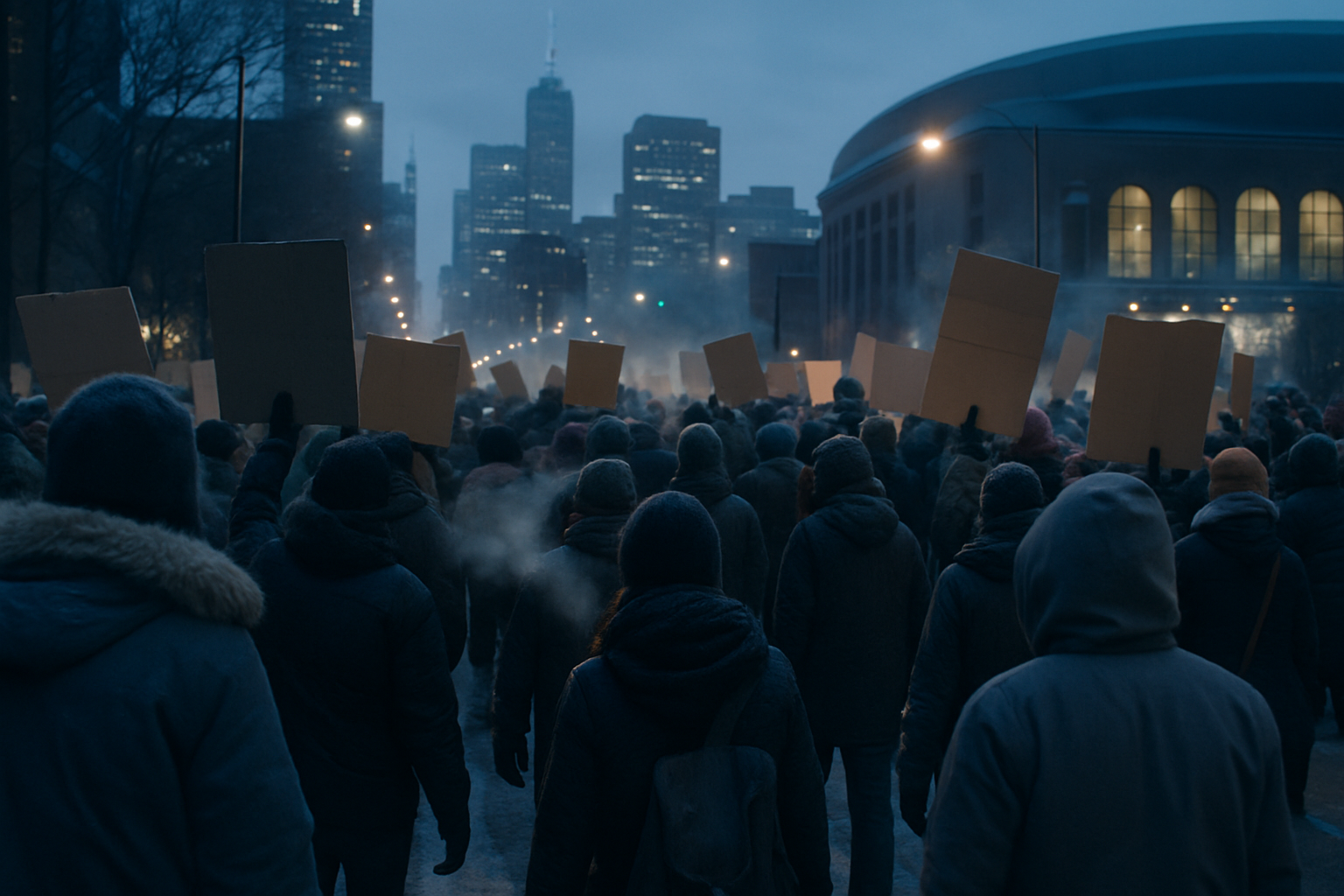

A massive anti-ICE march and rally in downtown Minneapolis on Friday, Jan. 23, 2026, drew thousands of people into subzero wind chills — a show of public resistance to a federal immigration crackdown that organizers and local officials say has crossed constitutional lines.
While the demonstration took place more than 1,400 miles from Longview and Kelso, the politics behind it are national — and the legal questions it raises about warrantless stops, retaliation against protest, and federal power are the same ones that matter here in Cowlitz County.
What happened in Minneapolis — and why
Participants gathered at The Commons park in downtown Minneapolis and marched to the Target Center, where a large anti-ICE rally was held. The action was framed as part of a broader “economic blackout” day urging people to skip work, school and shopping in protest of Immigration and Customs Enforcement activity in Minnesota.
National outlets reported that the “economic blackout” was backed by community leaders, clergy and labor groups, with hundreds of businesses closing for the day. The protest was also fueled by anger over the killing of Renée Good, a 37-year-old U.S. citizen, who was shot by an ICE officer earlier this month, according to reporting by Time and The Washington Post.
Time reported that organizers expected more than 20,000 participants at the Minneapolis demonstrations. The Washington Post described it as the state’s largest protest yet against ICE operations connected to “Operation Metro Surge.”
Operation “Metro Surge” and the court fight over protest rights
The Minneapolis demonstrations come amid multiple legal and political challenges to the Department of Homeland Security’s “Operation Metro Surge,” which Minnesota officials have described as an “unprecedented surge” of DHS agents into the state.
On Jan. 12, 2026, Minnesota Attorney General Keith Ellison, alongside the cities of Minneapolis and Saint Paul, announced a federal lawsuit seeking to end the operation and arguing it is unconstitutional and unlawful. In their public statement, Minneapolis officials said the operation has involved “thousands of armed and masked” DHS agents, including ICE and Customs and Border Protection, and cited what they called militarized raids and unconstitutional stops and arrests.
A federal judge has also stepped in to restrict certain tactics against peaceful protesters and observers. Multiple outlets reported that U.S. District Judge Katherine Menendez issued a preliminary injunction limiting federal agents from retaliating against lawful protest and from stopping drivers without reasonable suspicion of obstruction or interference.
Why this is locally relevant in Cowlitz County
Even when the flashpoint is elsewhere, the precedent is national: if federal agencies can expand enforcement operations, surveil communities, or chill protest rights in Minnesota, the same playbook can be deployed in Washington — including along the I-5 corridor that runs through Longview and Kelso.
For residents here, the questions are practical and immediate:
- What limits exist on federal enforcement actions? The Minnesota litigation and injunction highlight that courts can—and do—draw lines around the First Amendment right to protest and the Fourth Amendment limits on stops and searches.
- How do local governments respond? Minnesota’s attorney general and major cities chose to litigate. In Washington, local officials and law enforcement agencies face their own choices about cooperation, non-cooperation, and the use of local resources.
- What does “public safety” mean? Federal agencies often justify sweeps as targeting serious crime. Local reporting in Minnesota has raised disputes over who is actually being arrested and how broadly enforcement is being applied.
What we can verify — and what we can’t from this tip
The tip we received summarizes an article attributed to “Bring Me The News” describing the crowd size, the route (The Commons to the Target Center), and a broader economic blackout. We independently verified the larger statewide protest and the core context — including the Jan. 23 demonstration day, the Target Center rally, and the legal fight over Operation Metro Surge — through reporting from Time, The Washington Post, and a public statement from the City of Minneapolis.
We have not independently verified the specific crowd estimate quoted in the tip, nor the quote attributed to Minnesota Rep. Mike Howard, because the original “Bring Me The News” link was not provided.
Sources
- Time: “Minnesotans Shutter Businesses and Call Off Work in Economic Blackout Day to Protest ICE” (Jan. 23, 2026): https://time.com/7357523/minnesota-ice-protest-business-immigration-minneapolis/
- The Washington Post: “Thousands march in Minnesota and hundreds of businesses close to protest ICE” (Jan. 23, 2026): https://www.washingtonpost.com/nation/2026/01/23/minnesota-general-strike-ice-protest/
- City of Minneapolis: “State of Minnesota, Minneapolis and Saint Paul sue to halt ICE surge into Minnesota” (Jan. 12, 2026): https://www.minneapolismn.gov/news/2026/january/ag-lawsuit/
- The Guardian: “Minnesotans strike to protest ICE surge in state: ‘No work, no school, no shopping’” (Jan. 23, 2026): https://www.theguardian.com/us-news/2026/jan/23/minnesota-economic-blackout-ice-protests
We’ll continue tracking whether federal immigration enforcement expands similar operations in the Pacific Northwest, and what Washington state and local governments do—or refuse to do—in response.