

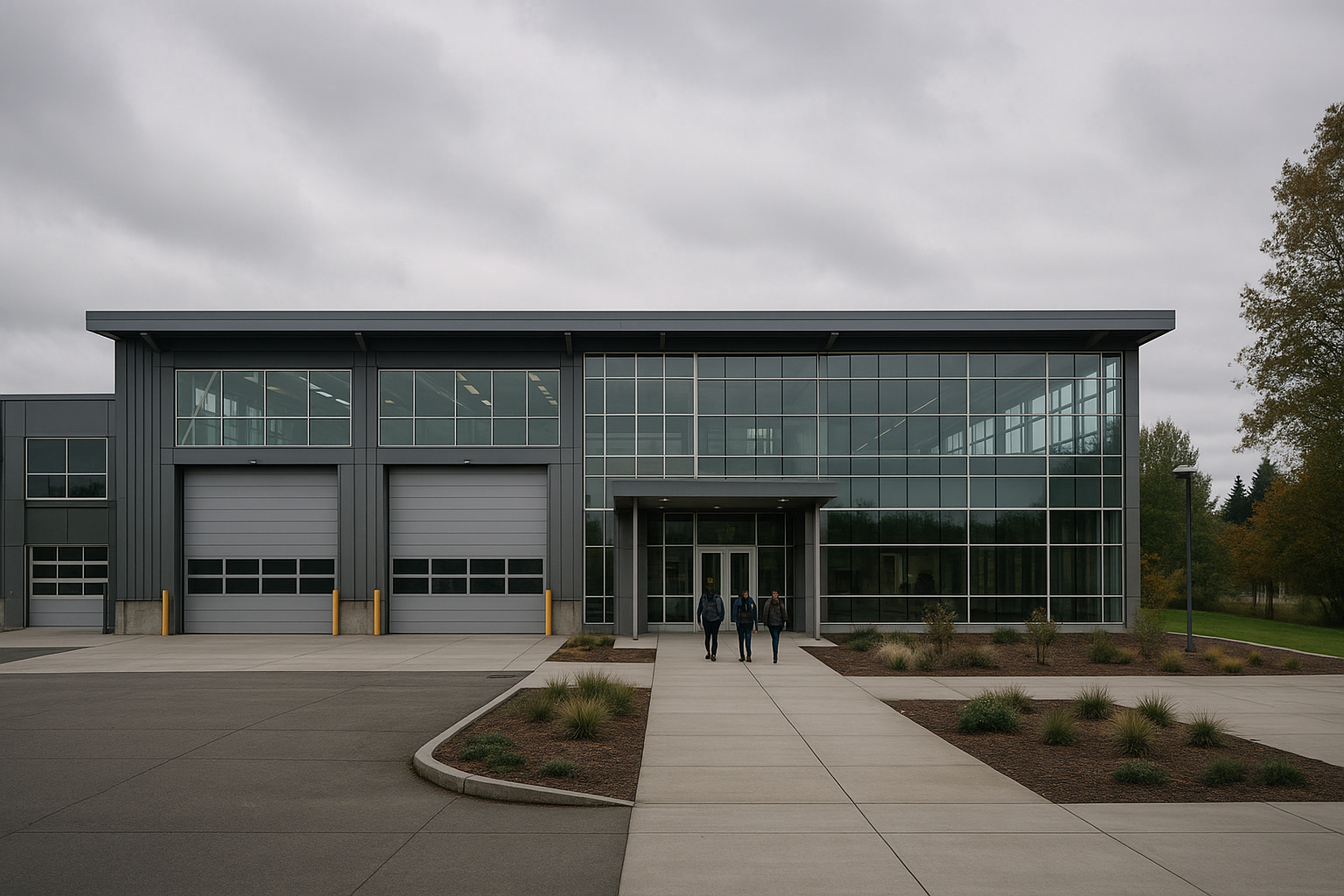

Clark College’s new Advanced Manufacturing Center (AMC) at Boschma Farms in Ridgefield is now open, marking a major expansion of workforce training capacity in the Portland-Vancouver metro’s north corridor — and a development with direct implications for job-seekers in Cowlitz County who commute, retrain, or pursue stackable credentials in the region.
Clark College publicly celebrated the facility with a ribbon cutting and grand opening event on Thursday, Jan. 8, 2026, at the Ridgefield campus location (7000 E. Pioneer Street, Ridgefield). The college has also described a “soft opening” period beginning in spring 2025, when general-education classes started being held in the building ahead of full program rollout.
The 49,000-square-foot facility is designed around a large “high bay” manufacturing floor intended to replicate real-world shop conditions, alongside classrooms, labs, collaboration space, and room for general education, continuing education, and Running Start offerings. According to Clark College and the Clark College Foundation, the building includes roughly 35,000 square feet dedicated to manufacturing training, with the remainder used for classrooms and student/faculty spaces.
What programs are planned — and when
Clark College announced in July 2025 that it would launch an Advanced Manufacturing program built around an Associate in Applied Technology (AAT) degree, with embedded and stackable certificates intended to let students enter, exit, and re-enter the training pipeline as their circumstances change. The first cohort was slated to begin classes in fall 2025, with the inaugural cohort’s expected graduation in spring 2027.
For residents of Longview, Kelso, Castle Rock, and the broader Cowlitz County area, the Ridgefield location is a comparatively closer option than some metro-area training sites. It also sits in a labor market shaped by cross-river commuting and regional manufacturing supply chains — meaning workforce investments on the Clark County side can have ripple effects for workers living in Cowlitz County.
Federal dollars: what we can confirm
The tip described “over $3 million” in federal support. In public materials, Clark College has specifically stated it received $1.5 million in federal earmark funding to support advanced manufacturing learning, including equipment and the high-bay learning environment. We were not able to independently verify the “over $3 million” figure in the college’s published releases and pages reviewed for this story.
That distinction matters because “federal support” can refer to multiple funding streams (earmarks, grants, or other federal programs), and totals sometimes get reported in aggregate across years or separate projects. Readers should expect clearer public accounting whenever taxpayer dollars are used to expand training pipelines for private-sector labor needs.
Why this matters locally
Workforce training is often framed as an uncomplicated win, but the local impact depends on how programs are structured and who actually benefits. If the new center delivers on its promise of accessible, stackable credentials and genuinely family-wage job pathways, it could provide a tangible on-ramp for displaced workers and working-class students — including those in Cowlitz County — who are trying to avoid debt traps or low-wage churn.
At the same time, public investments in “pipeline” programs can turn into a quiet subsidy for employers if wages, labor standards, and job placement outcomes don’t match the rhetoric. The public should keep an eye on whether regional manufacturers offer compensation that reflects the training, productivity, and public dollars behind these programs.
Sources
- Clark College release: Ribbon-Cutting and Grand Opening for the Advanced Manufacturing Center (Dec. 31, 2025): https://www.clark.edu/news-and-media/releases/2026/ribbon-cutting-and-grand-opening-for-the-advanced-manufacturing-center.php
- Clark College release: Clark College Launches Advanced Manufacturing Program (July 17, 2025): https://www.clark.edu/news-and-media/releases/2025/clark-launches-advanced-manufacturing-program.php
- Clark College visitor guide: Boschma Farms / Ridgefield location and address: https://www.clark.edu/about/visitors-guide/getting-to-clark/boschma/
- Clark College Foundation: Advanced Manufacturing Center overview (construction completion, facility details): https://clarkcollegefoundation.org/advanced-manufacturing-center/
Editor’s note: This story focuses on what can be confirmed through publicly available college releases and official pages as of Jan. 22, 2026.




Leave a Comment