



This afternoon, Governor Bob Ferguson and Attorney General Nick Brown delivered a sharp rebuke of recent Immigration and Customs Enforcement (ICE) operations in Minnesota—including what they describe as unconstitutional directives from the Department of Homeland Security to enter homes without judicial warrants—and vowed to defend Washingtonians’ constitutional rights. State leaders have made clear that, while they cannot stop ICE deployments outright, Washington will use every legal tool at its disposal to oppose any federal overreach on its soil.
In a press conference at the Capitol just hours ago, Ferguson and Brown cited troubling developments in Minneapolis: the fatal shootings of Alex Pretti and Renée Good at the hands of ICE agents, and reports of aggressive tactics used against peaceful observers and journalists at protests. A federal judge recently barred DHS agents from arresting or retaliating against peaceful demonstrators—ruling that such actions could chill First Amendment freedoms. This state-level response comes as Minnesota’s attorney general has filed suit to halt what he calls a dangerous federal escalation targeting immigrant communities. Washington’s leaders voiced solidarity with those efforts and echoed concerns about the erosion of civil liberties. Washington Post, The Guardian, Washington State Standard
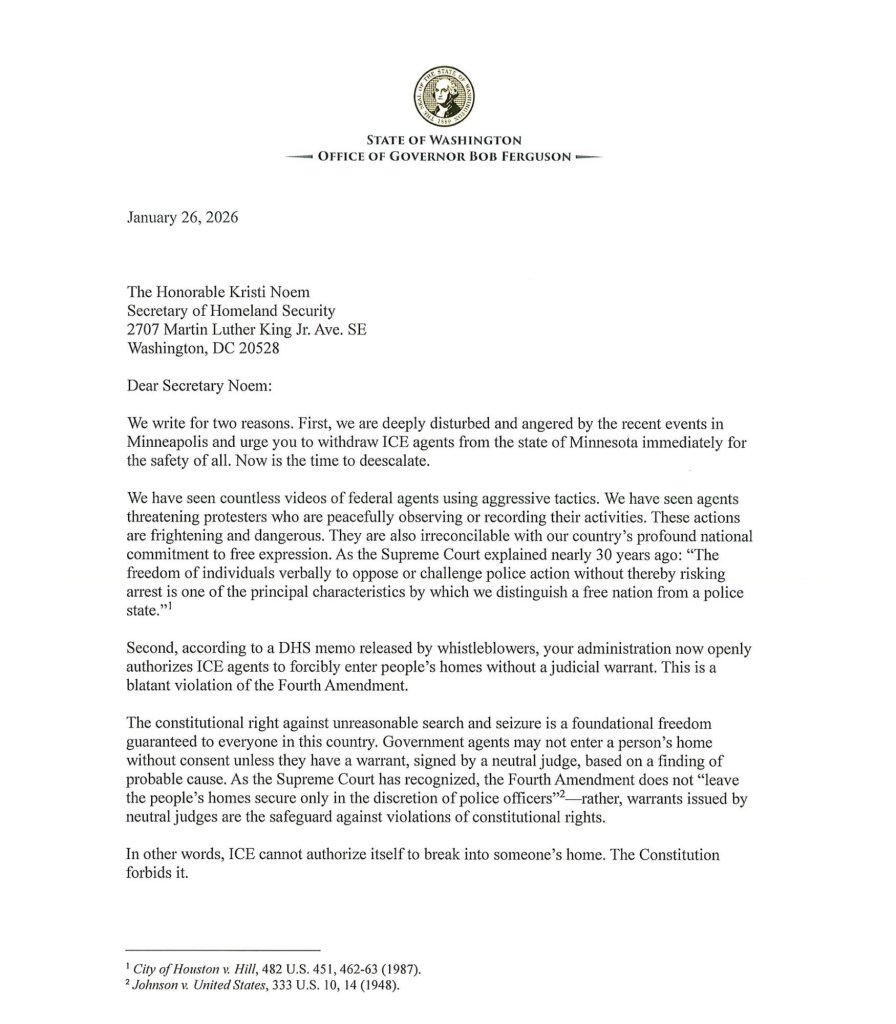
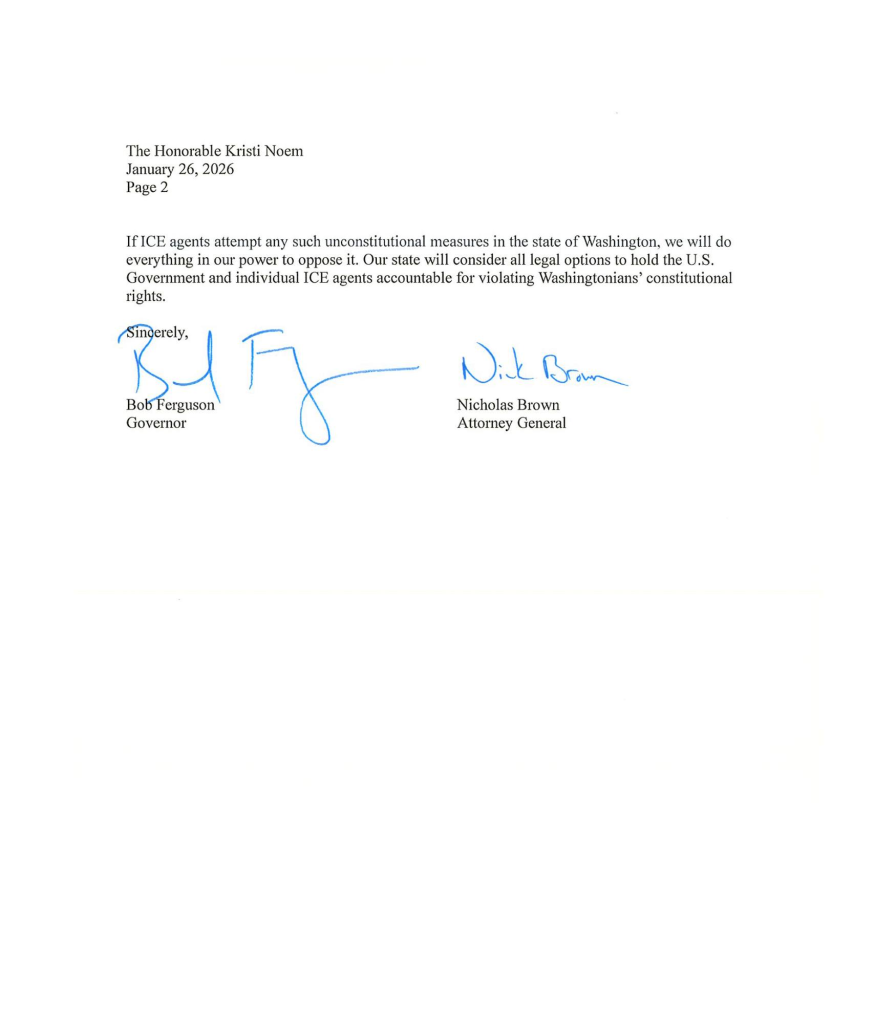
Ferguson and Brown also signed and sent a scathing letter to DHS Secretary Kristi Noem, demanding an immediate de-escalation and withdrawal of federal agents from Minnesota. The letter warns that a DHS memorandum reportedly authorizing ICE agents to enter homes without judicial warrants is an outright violation of the Fourth Amendment and must not be applied in Washington. The letter emphasizes that if ICE attempts similar unconstitutional measures here, the state will “do everything in our power” to push back and hold agents and officials accountable. Governor’s Office release, Washington State Standard
To prepare for possible federal escalation, the state has outlined a multi-pronged strategy:
- Adding the Chief of the Office of Refugee and Immigrant Assistance, Sarah Peterson, to cabinet meetings to enhance coordination around immigrant policy.
- Hiring a senior advisor, David Kim, focused specifically on immigrant and refugee policy issues.
- Consulting with Major General Gent Welsh, Adjutant General of the Washington National Guard, to develop scenario planning and protective responses.
- Engaging local, state, and federal partners to ensure coordinated, quick responses to emerging enforcement activity.
- Backing legislation such as Senate Bill 5855 (barring law enforcement from wearing face coverings) and related bills targeting ICE impersonation and employer cooperation without warrants. These measures are intended to make enforcement more transparent and limit harm. The Attorney General is also co-sponsoring an Immigrant Worker Protection Act to require employers to notify workers about federal information requests. Governor’s Office release
These developments continue a long tradition of resistance to authoritarian federal overreach under both Ferguson and Brown. The Governor previously fought attempts by the Trump administration to label Washington a “sanctuary state” and resist threats from the U.S. Attorney General, including potential criminal charges. In 2019, the Washington Attorney General sued the Trump administration over courthouse arrests that targeted immigrant community members seeking access to justice. These earlier efforts reflect a consistent commitment to defend civil liberties against unjust federal action. Spokesman-Review, Washington Attorney General Office
The local implications are clear: while Washington cannot veto ICE deployment, it can mobilize the legal, political, and community-based defenses that tilt the scales back in favor of liberty. Residents are also being urged to monitor and document interactions with federal officers—because democracy only thrives when people bear witness and speak out.
This story connects to ongoing coverage of ICE operations and civil rights in our region, following earlier reporting on Washington’s sanctuary policies, the Keep Washington Working Act, and the state’s historical resistance to federal immigration overreach.
What to watch next: passage of the proposed bills in the Legislature, whether ICE attempts enforcement action in Washington state, and whether legal challenges from Minnesota succeed in curbing federal tactics.



Leave a Comment