

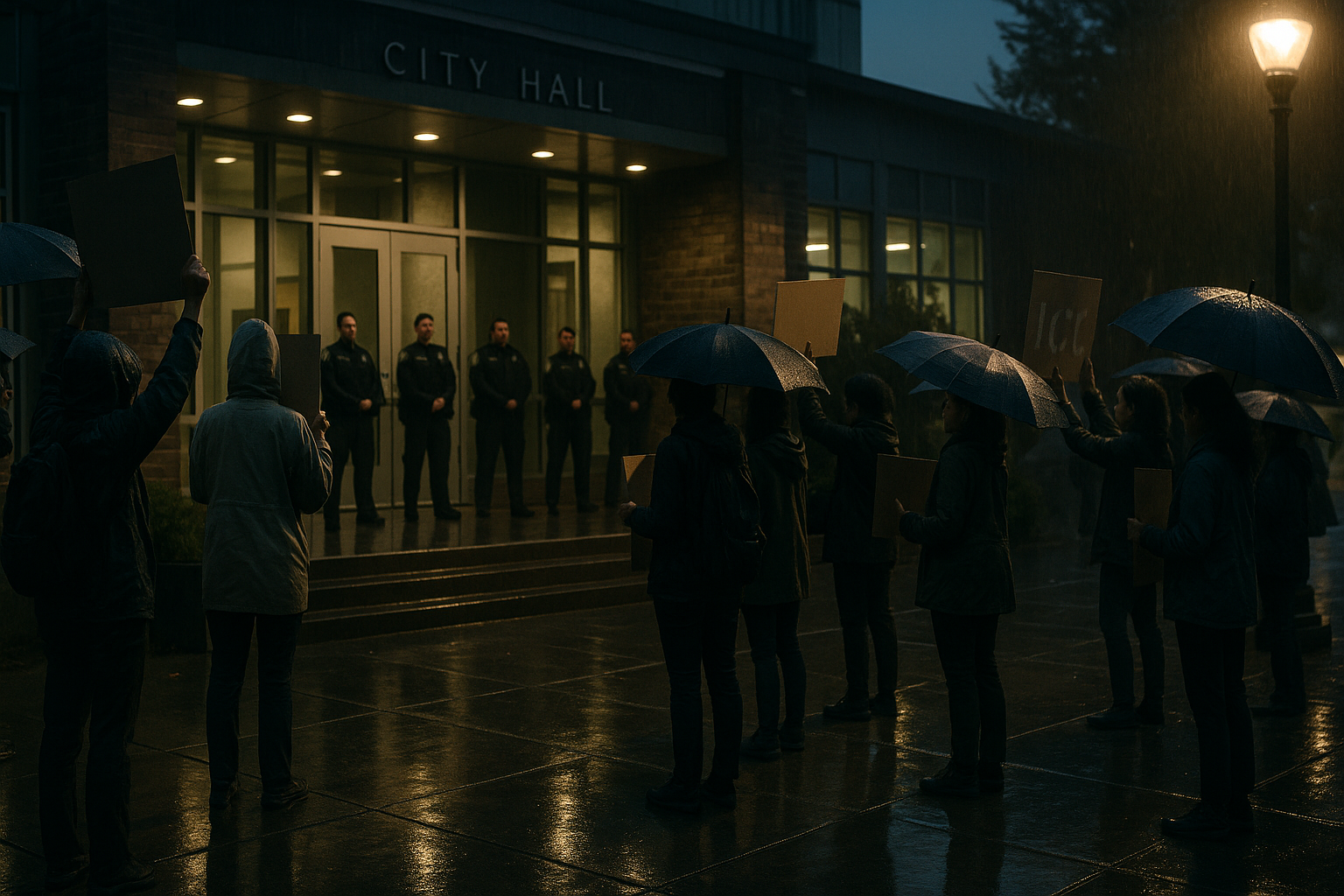

A protest demanding that Portland revoke the land-use approval for the city’s U.S. Immigration and Customs Enforcement (ICE) facility spilled into City Hall during a Wednesday night city council meeting, prompting authorities to remove demonstrators and later confirm that pepper spray was used outside the building.
While the incident occurred in Portland, it has local relevance in Cowlitz County because many Southwest Washington families move, work, and travel across the I-5 corridor—and because federal immigration enforcement and policing tactics used at protests can ripple across the region. The question raised by the Portland protest is one Cowlitz residents increasingly face as well: what does it mean for “public safety” when government agencies respond to dissent with chemical agents?
What happened at City Hall
According to reporting by FOX 12 Oregon, demonstrators rallied ahead of the meeting and then entered council chambers chanting “Revoke the permit,” urging the council and Mayor Keith Wilson to revoke the ICE facility’s land-use permit. The disruption halted the meeting; FOX 12 reported that the council shifted the meeting online after tensions escalated inside the building.
Organizers told FOX 12 they were forcibly pushed out of the chambers and out of City Hall. One organizer alleged people were shoved down stairs and that pepper spray was used during the removals.
Columbia County Counter Current could not independently review KOIN 6’s original report due to access restrictions, but multiple outlets described the same core claims: protesters were removed from City Hall, and pepper spray was used outside the building.
Why the “permit” matters—and what Portland officials say is (and isn’t) possible
The protest’s central demand—revoking the ICE facility’s land-use approval—has been a flashpoint in Portland for months. City officials have publicly stated that revocation cannot simply be done by a political vote, but must proceed through a formal land-use enforcement process that can take significant time and includes administrative review and appeal steps.
In a December 2025 FAQ, Portland City Councilor Angelita Morillo’s office stated that revocation can only occur through Portland’s administrative enforcement process and that attempting to “revoke the permit” through legislation would likely be overturned in court. The same FAQ warns that councilors publicly advocating for a specific quasi-judicial outcome could jeopardize their ability to participate in later appeals tied to that enforcement process.
This procedural reality has helped fuel ongoing protests: organizers argue that lengthy administrative timelines function as delay while ICE continues operating, while city officials emphasize they are constrained by state and local land-use rules and due-process requirements.
Local implications for Cowlitz County: protest, policing, and the use of chemical agents
In Cowlitz County, residents have seen how quickly national politics can become local conflict—especially when immigration, policing, and public demonstrations intersect. The Portland City Hall incident is a reminder that the question isn’t only “what are people protesting,” but also “how does government respond when people protest inside public buildings?”
Chemical agents such as pepper spray, pepper balls, and smoke are often framed as “less-lethal,” but their use still raises serious civil-liberties and public-health concerns—particularly in enclosed spaces, near vulnerable people, or when deployed against crowds. Even when used outside a building, pepper spray can drift, linger, and affect bystanders.
For local readers watching events in Portland, the lesson is concrete: tactics used in larger cities can set expectations—formal or informal—for how authorities handle demonstrations elsewhere in the region. It also underscores the importance of clear public policies, transparent after-action reporting, and accountability when force is used during political expression.
What we’re watching next
In Portland, the immediate questions are whether body-worn camera footage or additional official reports will clarify who deployed pepper spray, under what circumstances, and whether any injuries were documented. Separately, the longer-running fight over the ICE facility’s land-use status will likely continue through administrative processes and political pressure campaigns.
For Cowlitz County residents, this story is less about Portland personalities and more about a regional pattern: federal immigration enforcement, local government constraints, and the growing normalization of force at the edge of civic participation.
Sources
- FOX 12 Oregon (KPTV): https://www.kptv.com/2026/01/22/protest-takes-over-portland-city-council-meeting-protesters-allegedly-pepper-sprayed-by-police/
- Portland.gov (Councilor Angelita Morillo): https://www.portland.gov/council/districts/3/angelita-morillo/news/2025/12/3/macadam-ice-facility-permit-updates-and-faq
- Portland Tribune (Nov. 19, 2025 coverage of City Hall rally): https://portlandtribune.com/2025/11/19/crowd-rallies-at-portland-city-hall-to-urge-revocation-of-ice-facility-permit/


Leave a Comment