

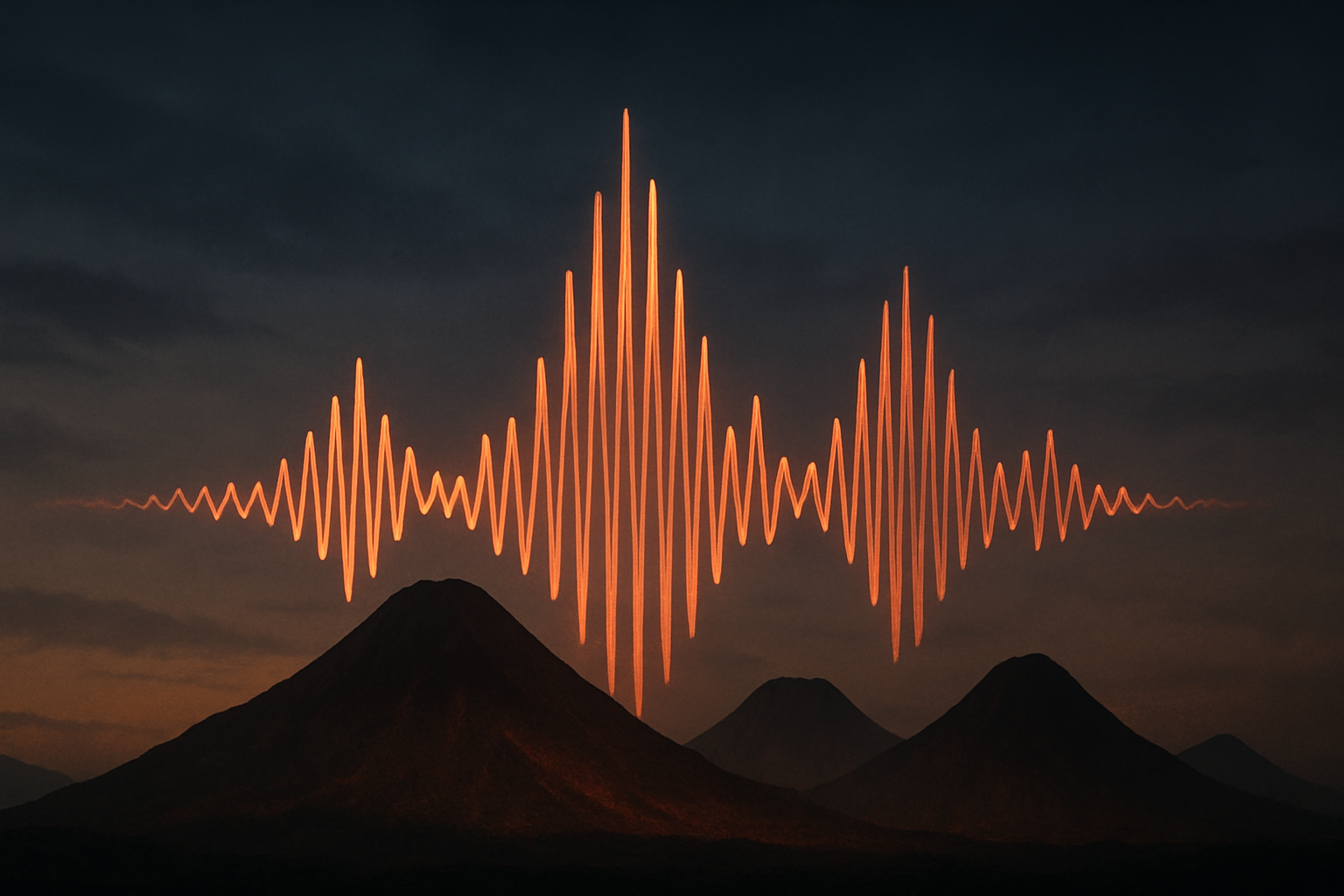

University of Oregon associate professor Leif Karlstrom has turned volcanic data into music through his Volcano Listening Project—an innovative blend of geophysics, sonification, and live performance. His work was recently featured on OPB’s Think Out Loud, where it was described how Karlstrom transforms data from volcanoes like Mount St. Helens and Kīlauea into soundscapes and collaborates with musicians to create compositions that are at once scientifically informed and artistically expressive OPB report.
Karlstrom’s approach varies by dataset: field recordings—such as the crunch of fresh tephra on Kīlauea—anchor the album in the physical experience of volcanoes. Other tracks translate seismic or eruption data into sound through sonification. For instance, “650 Years of Global Explosive Eruptions” encodes eruption magnitude, composition, and volcano type into musical elements. Another track, “Mount Saint Helens Drumbeat Seismicity and Eruption, 2004,” speeds up subaudible seismic frequencies—known as drumbeat seismicity—making the pre-eruption tremors audible and emotionally resonant OPB report.
The project’s album was released in August 2024 via Adhyâropa Records. It features contributions from a diverse group of artists: Stash Wyslouch on guitar, Billy Contreras on violin, Jonny Rodgers on tuned glass, Idit Shner on bass clarinet, Todd Sickafoose on synthesizers and guitar, and others. Performances were recorded across studios in Nashville, Eugene, San Francisco, and Columbia University in New York City Album details.
Live performances accompanied the album’s release in early 2026. A sold‑out show at Eugene’s Art House took place on January 25, followed by shows in Portland on January 28 and two performances in Hood River on January 29. These events combined lecture elements, sonified performances, and live instrumentation, featuring the ensemble behind the recordings and emphasizing both scientific context and musical innovation Project site; Portland event; Hood River event; KLCC/Eugene show).
Why this matters
Karlstrom’s work expands the frontier of scientific communication. Sonification turns intricate, often invisible, geophysical processes into sensory experiences that can engage both the scientific mind and the emotional limbic system. This dual approach has the potential to deepen audience understanding and appreciation of volcanic behavior while opening new pathways for outreach.
Even though this work originates outside of Cowlitz County, the local interest in volcano science—especially around Mount St. Helens—makes the project highly relevant. Sonified data from Mount St. Helens allows local residents to perceive the seismic rhythms of this iconic volcano in an entirely new medium. It also illustrates how place-based science can be translated into public art, forging deeper connections between community and environment.
Columbia Countercurrent will continue to monitor how sonification projects like this intersect with public understanding of volcanic hazards, hazard preparedness, and cultural expression in the Pacific Northwest.




Leave a Comment