

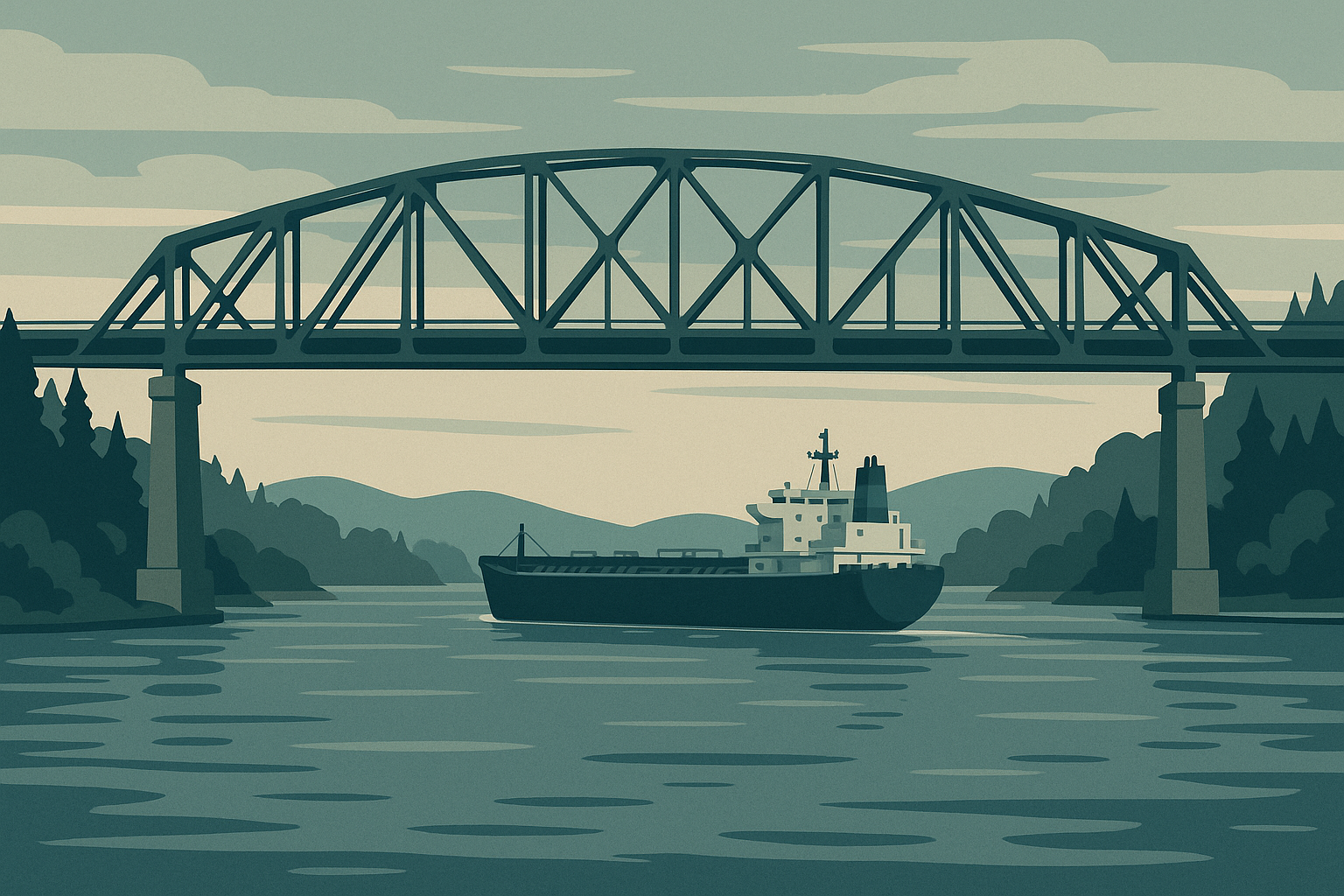

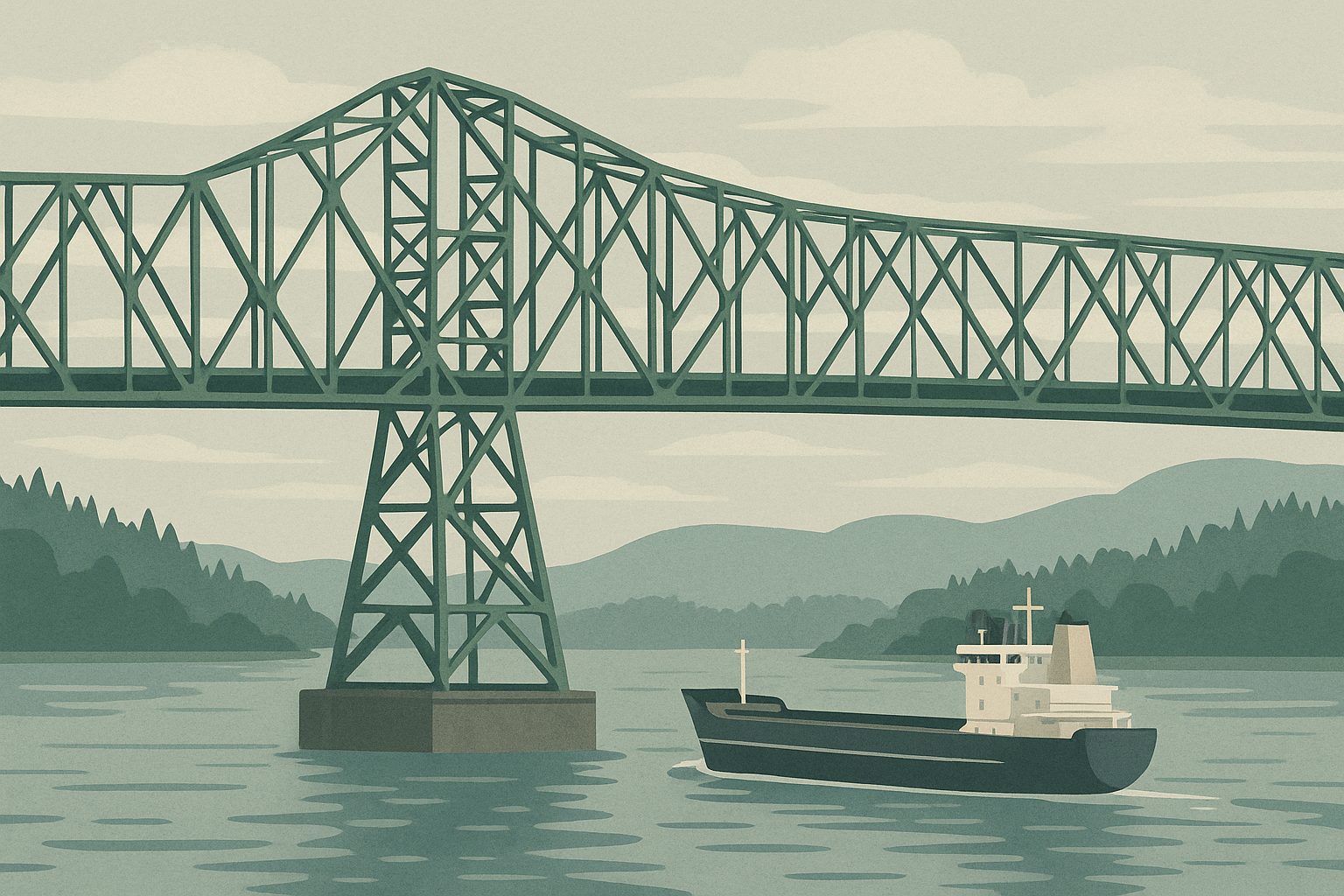
Maritime pilots responsible for guiding deep‑draft vessels on the Columbia River say the margin of safety at the Lewis and Clark Bridge has narrowed to a point that warrants urgent attention from state and federal officials. Their concerns focus on an aging crossing, rapidly expanding ship sizes, and a river channel that brings vessels within tight proximity of bridge supports as they round the bend at Longview.
According to statements made by Capt. Jeremy Nielsen, president of the Columbia River Pilots, a vessel departing the Port of Longview in early February lost power as it passed beside the bridge. Tugboats assisting the transit redirected immediately, preventing the vessel from drifting toward the structure. Nielsen said such mechanical failures occur throughout the Columbia River system several times each month, and although most resolve quickly, the location of an outage can determine whether pilots have room to maneuver.
The bridge connecting Longview and Rainier sees roughly 3,000 commercial transits per year. Nielsen said a cruise vessel passing under the span in 2022 cleared the bridge deck by just over four feet based on available measurements. Subsequent discussions with transportation officials in Washington and Oregon indicated the structure can flex by about two feet under certain conditions, reducing that clearance significantly. The Washington State Department of Transportation confirmed that the bridge is designed to flex but did not provide a current measurement of the total sag.
River pilots have pushed for installation of electronic air‑gap sensors on the span for more than a decade, arguing the equipment would give real‑time information about available clearance. Nielsen said the technology would help restore safety margins that have eroded as vessels have grown taller and wider. The Lewis and Clark Bridge does not currently have such sensors, and unlike some newer crossings, its piers lack protective concrete barriers designed to absorb vessel impacts.
Several recent assessments have highlighted concerns about the bridge’s vulnerability. A 2025 report from the National Transportation Safety Board, available at this official NTSB document, identified the Lewis and Clark and Megler bridges as the only essential water‑crossing structures in the Pacific Northwest whose risk of collapse from a vessel strike remains undetermined. A year earlier, an analysis by the Wall Street Journal reported that the Longview crossing was among several U.S. bridges with structural characteristics similar to the Francis Scott Key Bridge in Baltimore, which collapsed in March 2024 after a container ship lost power and struck a pier.
Pilots say ship sizes — including those serving the Port of Longview and cruise traffic bound for Portland — have grown faster than infrastructure built nearly a century ago. U.S. Army Corps of Engineers records show the authorized channel width near the bridge has increased since its construction in 1930, but pilots note that the alignment of the deepest water still requires large vessels to pass close to the Washington‑side support column. Capt. Nick Ritter, vice president of the Columbia River Pilots, said the design of modern ships, which often have tall structures at both the bow and stern, leaves less room for error when threading under the span.
Industry groups and the pilots’ association have spent years urging lawmakers and transportation agencies to invest in hazard‑reduction measures, including sensors and adjustments to the channel’s alignment. State and federal agencies are now reviewing potential changes, according to information shared with pilots and industry representatives.
Local officials and maritime operators continue to evaluate these risks as vessel traffic remains central to the economies of Longview, Kelso and surrounding communities. Any significant disruption — whether from a near‑miss or a structural failure — would have broad implications for both regional industry and interstate transportation.
Sources
Washington State Standard: River pilots see vessels come within feet of hitting bridge over Columbia River near Longview
National Transportation Safety Board: 2025 marine accident risk assessment
Wall Street Journal: Bridge vulnerability analysis

Leave a Comment