

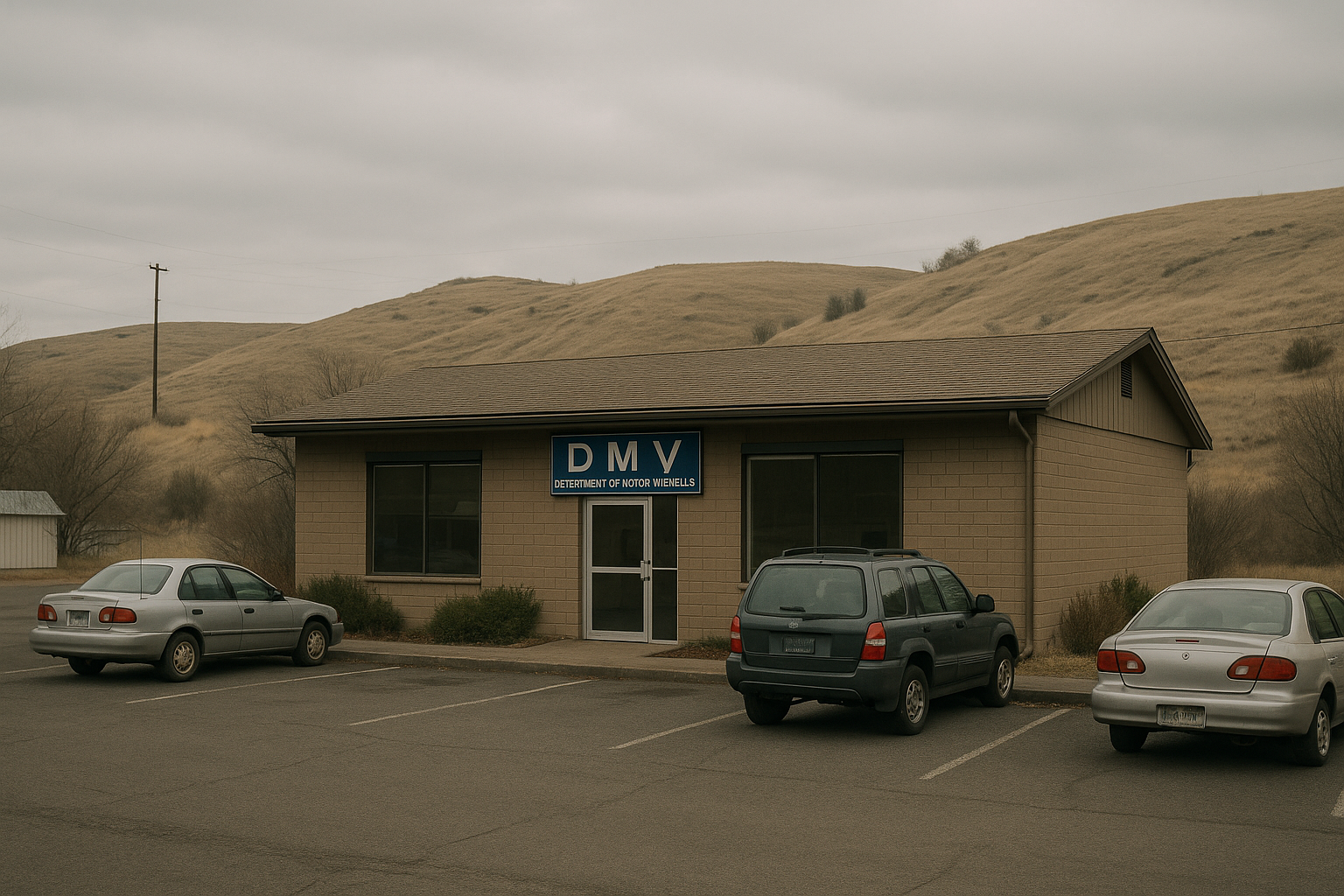

Rural communities across Oregon are facing growing barriers to basic transportation services as staffing shortages and budget constraints push the state’s Department of Motor Vehicles (DMV) to scale back operations — or close smaller field offices altogether. The impact, while most acute in places like Condon and Milton-Freewater, could soon reach communities along the Columbia Basin, including those in southwest Washington who depend on cross-border mobility for work, commerce, and family ties.
According to Oregon Public Broadcasting, temporary DMV closures — once rare events — have become commonplace. Oregon Department of Transportation data confirm that DMV locations were closed for at least 79 days due to staffing shortages in 2022, and 126 days in 2023. While that number has since dropped, closures remain elevated, particularly in rural areas that rely on small, understaffed field offices.
In Condon, population under 2,000, the DMV now operates just one day a month. Residents wait for hours to renew licenses or register vehicles, knowing that missing the monthly service window means another month of delay. “We learn to deal with it living rurally,” said Rock Creek resident Tim McDonald, reflecting on the lack of convenience in small-town life. But for many, the situation is less about patience and more about access: a round trip to the next nearest DMV could mean driving up to 170 miles.
Meanwhile, in Milton-Freewater — home to about 7,000 people near the Oregon-Washington border — the DMV has been closed indefinitely since August 2025 following the retirement of one of two employees. Mayor Michael Odman described it as a blow to a town already struggling to maintain essential services after losing a full-service pharmacy and seeing reduced medical access in recent years. Until the Milton-Freewater office reopens, residents must travel to Pendleton, 30 miles away, for even simple transactions.
DMV Administrator Amy Joyce said that staffing has remained flat for 25 years even as Oregon’s population has grown significantly. A quarter of DMV positions remain vacant — a shortage compounded by a $297 million statewide transportation funding gap now under consideration by legislators. Joyce warned that deeper cuts could result in permanent closures for some rural locations, further reducing service availability.
This logistical strain also underscores a larger regional divide in service accessibility across the Pacific Northwest. Many Cowlitz County residents who cross into Oregon for business, education, or healthcare rely on Oregon’s DMV system for vehicle and license matters. A prolonged rural service decline could mean longer waits at larger regional offices, such as in The Dalles or Pendleton, which already see surges in out-of-area visitors on reduced staffing days.
Efforts to ease the crunch include new self-service kiosks in urban Fred Meyer stores for registration renewals, but such innovations do little for residents without reliable internet or easy access to larger towns. For eastern Oregon and border communities, the story remains one of resilience — and waiting.
“Everything’s going to slow down, take longer, that sort of thing, if we get into that worst-case scenario,” Joyce said.
For now, the Condon DMV still opens its doors every first Thursday, for five short hours. At closing time, the line disappears — and the countdown to next month begins again.
Sources: Oregon Public Broadcasting: “As DMVs struggle to keep their doors open, rural Oregonians are harder hit”; Oregon Department of Transportation public data.