

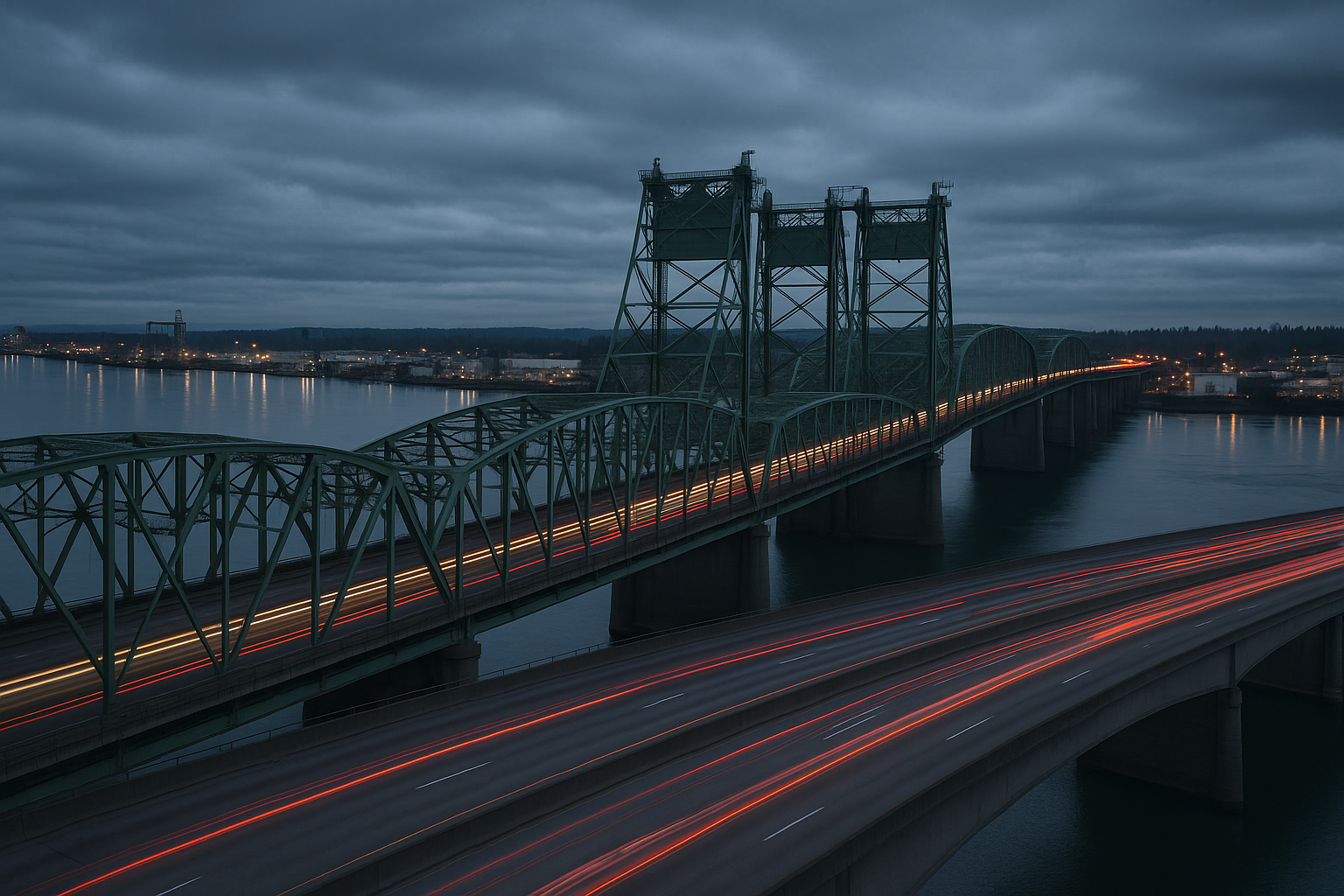

Leaders of the Interstate Bridge Replacement (IBR) Program are facing renewed scrutiny over transparency and communication after project cost documents obtained through public records requests showed far higher estimates than the public-facing figures many officials have continued to cite.
The controversy matters locally even though the bridge sits downriver: the I-5 bridge between Vancouver and Portland is a major freight and commuter artery that shapes traffic patterns, shipping costs, and regional priorities that ripple north into Cowlitz County. When state budgets tighten around mega-projects, smaller communities can feel it first—through delayed maintenance, fewer safety projects, and renewed pressure for user fees like tolls.
What’s driving the latest backlash
At a Dec. 15, 2025 public hearing of the bi-state legislative committee overseeing IBR, project staff told lawmakers they did not have updated cost estimates beyond the December 2022 range that placed the program around $6 billion (often framed publicly as $5 billion to $7.5 billion). But reporting published Jan. 7, 2026 described internal project documents showing consultants had completed detailed updated estimates by Aug. 15, 2025—months before that December hearing—placing a fixed-span option at about $13.6 billion. In that reporting, Washington state Rep. John Ley (R-Vancouver) and Oregon state Rep. Thuy Tran (D-Portland) said they felt misled. (Source: https://www.wweek.com/news/state/2026/01/07/interstate-bridge-staff-hid-information-about-ballooning-cost-of-giant-highway-project/)
Program leadership has responded by arguing the figures circulating publicly were draft “basis of estimate” materials that had not yet gone through a complete validation process, and that a final number was not ready to share. (Source: https://www.wweek.com/news/state/2026/01/07/interstate-bridge-staff-hid-information-about-ballooning-cost-of-giant-highway-project/)
Costs may be even higher in other documents
A separate report published Jan. 22, 2026 cited Oregon Department of Transportation documents showing a wider range of estimates for the fixed-span concept—approximately $12.2 billion to $17.7 billion—following a key U.S. Coast Guard determination supporting a fixed span with 116 feet of clearance. That report also said an official cost estimate was expected in March 2026, while major funding questions remain. (Source: https://djcoregon.com/news/2026/01/22/interstate-bridge-replacement-costs-17-7-billion/)
What IBR’s website still says
As of the most recently available update on IBR’s public “Cost, Funding & Economic Benefits” page, the program still describes its “2022 cost estimate” as $5 billion to $7.5 billion (with a “likely” estimate of $6 billion) and describes tolling as part of the funding mix for construction, operations, and maintenance. (Source: https://www.interstatebridge.org/EconomicBenefits)
Tolling remains politically explosive
Even outside the Portland-Vancouver metro, tolling has been a persistent flashpoint because it hits working commuters first and can reshape how people route trips across the region. Clark County’s elected leaders previously took a formal position opposing tolling on I-5 and I-205 corridors, warning that tolls disproportionately affect wage workers and those with less ability to shift work hours—while acknowledging tolling may be considered for initial construction if it includes a “sunset.” (Source: https://clark.wa.gov/councilors/county-council-adopts-resolution-opposing-tolling-i-5-and-i-205-corridors)
Why this should matter in Cowlitz County
From a Cowlitz County perspective, the tension here is not just sticker shock—it’s governance. If the region’s biggest transportation project can swing from a public range of $5–$7.5 billion to internal projections more than double that without clear, timely disclosure to oversight bodies, that raises broader questions about democratic control of infrastructure planning.
It also intersects with our daily realities: freight traffic on I-5, port-related logistics, and the long-term public costs of deciding that highway expansion and megaproject delivery timelines should outrank transparency. For residents who already feel squeezed—by rent, health costs, and stagnant wages—large toll-funded projects can function like regressive taxes unless paired with meaningful low-income protections and real public accountability.
What to watch next
State transportation commissions and legislators in Oregon and Washington are expected to see more formalized cost information in early 2026, with some reporting indicating March 2026 as a target for an official estimate. Meanwhile, the gap between what the public is told and what internal documents show will likely continue to shape public trust—and the political viability of tolling and future funding packages. (Source: https://djcoregon.com/news/2026/01/22/interstate-bridge-replacement-costs-17-7-billion/)
Sources
- Willamette Week (Jan. 7, 2026): https://www.wweek.com/news/state/2026/01/07/interstate-bridge-staff-hid-information-about-ballooning-cost-of-giant-highway-project/
- Daily Journal of Commerce (Jan. 22, 2026): https://djcoregon.com/news/2026/01/22/interstate-bridge-replacement-costs-17-7-billion/
- IBR Program official page (“Cost, Funding & Economic Benefits”): https://www.interstatebridge.org/EconomicBenefits
- Clark County Council (Nov. 3, 2022): https://clark.wa.gov/councilors/county-council-adopts-resolution-opposing-tolling-i-5-and-i-205-corridors

Leave a Comment