

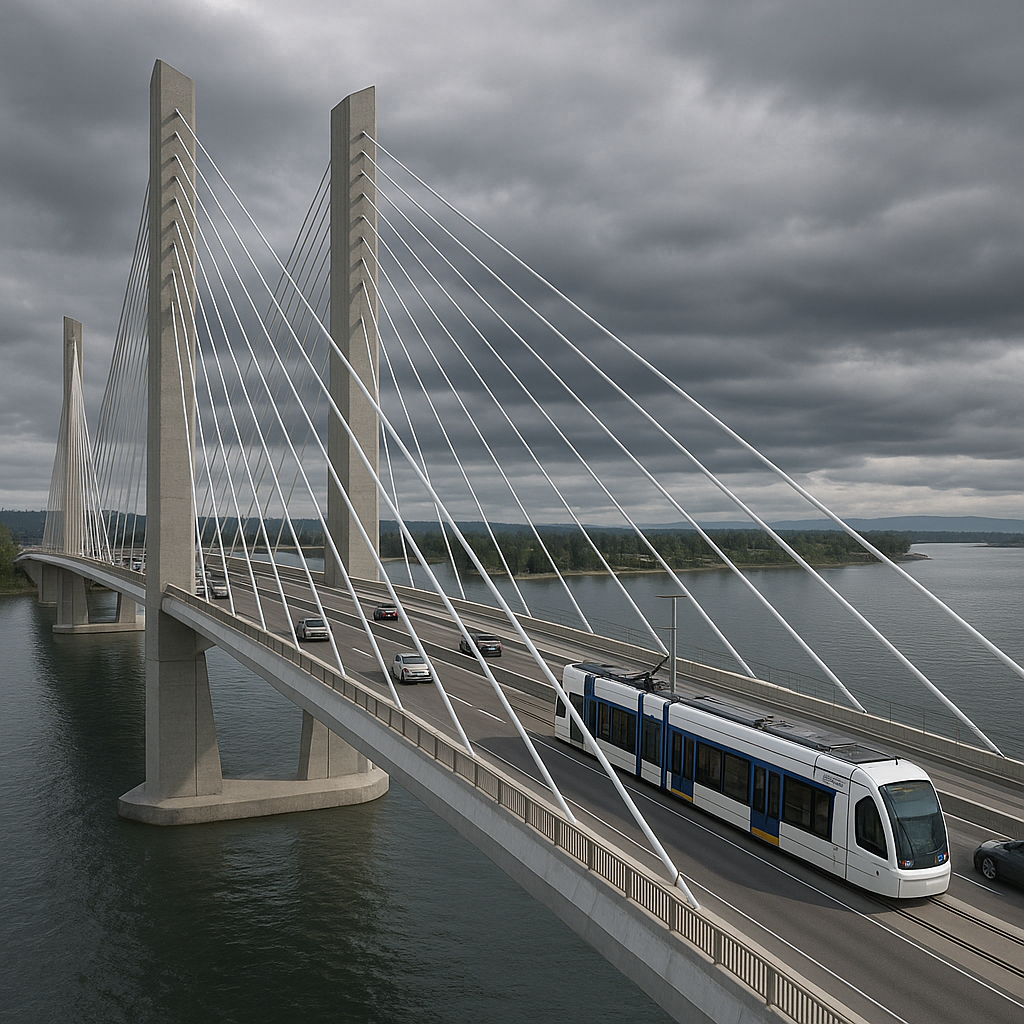

A recently approved federal spending package includes $100 million in funding for light rail construction as part of the Interstate Bridge Replacement (IBR) effort between Portland and Vancouver. The allocation comes from nearly $1.7 billion in capital investment grants to be distributed through the Federal Transit Administration, according to reporting by Oregon Public Broadcasting. President Donald Trump signed the measure on Tuesday as part of a broader package intended to resolve a partial federal government shutdown.
The $100 million specifically earmarked for the I-5 crossing underscores Washington and Oregon’s continued division over light rail’s role in the bridge project. The corridor — a vital commuter and freight route connecting Clark and Multnomah counties — has been under planning and review for years, with cost projections that have steadily climbed. The current replacement cost is estimated between $5 billion and $7.5 billion, though officials anticipate updated, higher figures in coming months.
Sen. Patty Murray (D-Wash.), vice chair of the Senate Appropriations Committee, called the appropriation a “major win-win” for the region, emphasizing the potential for improved connectivity. Staff in Murray’s office highlighted that the inclusion of a named line item for the IBR light rail component makes those federal dollars more difficult to redirect elsewhere, a notable point given the historically limited federal support for urban transit under the Trump administration.
Rep. Ed Orcutt (R-Kalama), who serves on the bi-state legislative committee overseeing the project, voiced continued skepticism. He argued that removing light rail should be a priority given the escalating costs, suggesting the program should be “peeled off” before additional funding is committed. Yet project planners say such a removal could jeopardize coordination between states and delay other federal support. Light rail remains part of the officially approved construction plan, known as the “Modified Locally Preferred Alternative.”
According to IBR documentation, the light rail segment — including track and stations — could cost roughly $290 million, based on a 2024 estimate. That figure excludes associated structural elements like bridges and ramps. Both Oregon and Washington have already pledged $1 billion each toward the project, and any design modification could reset federal review timelines.
For residents of Southwest Washington, the debate is likely to intensify as costs rise and final design decisions near. Advocates point to long-term benefits for commuters and reduced bridge congestion, while critics see the light rail component as an expensive add-on to a project already facing inflationary pressures and complex interstate politics.

Leave a Comment